Standard Off-Road vs Full Off-Road Caravans: What Is the Difference?
October 30, 202611 min read
Your choice of standard or full off-road caravan depends on where you plan to travel in Australia. To get a feel for the landscape, you can compare off-road options and browse off-road caravans. Off-road models designed for highway touring and maintained gravel roads are generally more reliable than full-off-road models designed for rough tracks and extended corrugations.
The key differences are in suspension, ground clearance, chassis construction, and terrain suitability, including common suspension types. By comparing these features and measurable specifications, such as caravan weight ratings and clearance, you can select a caravan that matches your travel objectives.
Standard Off-Road vs Full Off-Road Caravans: Key Differences
Feature
Standard Off-Road Caravans
Full Off-Road Caravans
Intended use
Highway and maintained unsealed-road touring
Regular rough-road and remote touring
Suspension
Leaf-spring or upgraded independent systems
Often heavy-duty independent suspension
Ground clearance
Suitable for formed roads, depending on design
Often greater clearance for uneven terrain
Chassis
Conventional or reinforced chassis
Often purpose-engineered, reinforced chassis
Underbody protection
Selected guards and stone protection
More extensive protection for tanks and plumbing
Coupling
Conventional or off-road-rated coupling
Commonly articulating off-road coupling
Terrain
Gravel roads and formed dirt tracks
Rougher tracks and sustained corrugations, where approved
Weight
May be lighter
May be heavier due to additional reinforcement
Main advantage
Practical everyday touring
Greater rough-terrain capability
The differences are typical, not fixed industry standards. As Australian regulators do not define a universal off-road caravan performance category, actual specifications and manufacturer approval matter more than the label—so check guidance from caravan manufacturers and specialist off-road caravan manufacturers.
Suspension: How Much Difference Does It Make?
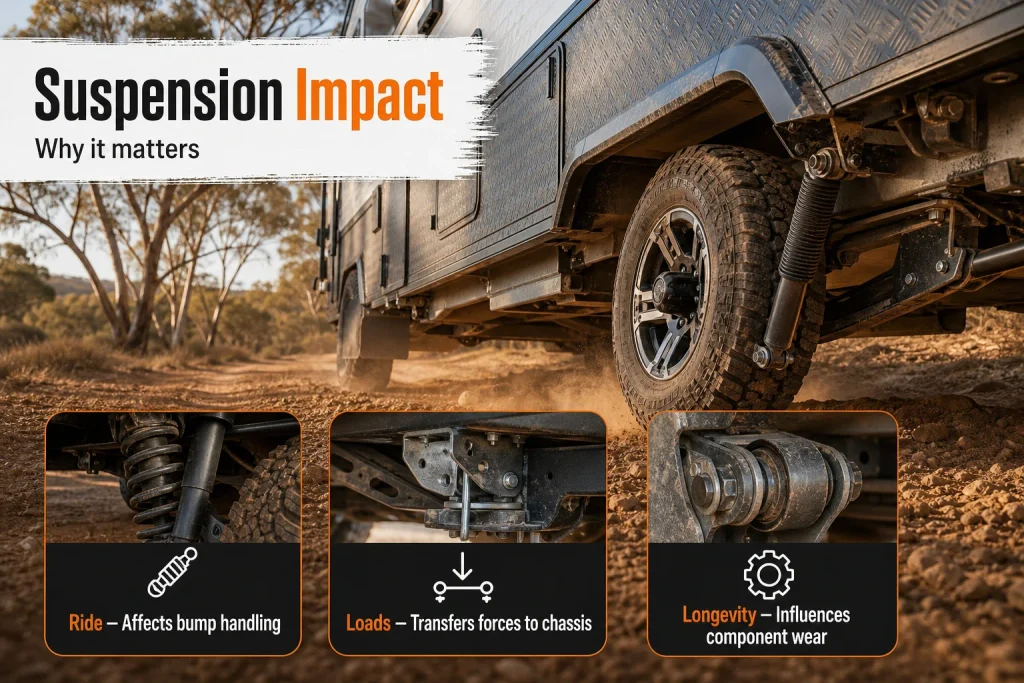
Caravan suspension determines how well it handles bumps, corrugations, and uneven surfaces. In addition, it influences the loads that are transferred into the chassis and body of the vehicle.
Standard Off-Road Caravan Suspension
In off-road caravans, leaf springs, upgraded suspension components, or independent suspension may be used.
Depending on the model, these systems can be used for highway travel, gravel roads, and occasional uneven surfaces; if you prioritise road touring, explore current touring caravan listings.
Repeated corrugations, however, can generate significant heat and vibration. Towing speed, tire pressures, suspension condition, shock absorber performance, and shock absorber rating all influence how well a caravan handles these circumstances. For safe speeds and setup on the road, review caravan towing basics.
Full Off-Road Caravan Suspension
A full-size off-road caravan will often be equipped with heavy-duty independent suspension, coil springs, and shock absorbers. If you’re evaluating dedicated designs, see recent full off-road caravans.
The systems are typically designed to accommodate greater wheel movement and repeated rough-road loads.
Rather than judging suspensions by their appearance, compare their actual specifications. A quick primer on the semi off-road vs full off-road naming can also help.
Suspension Check
What to Look For
Load rating
Must accommodate the caravan’s rated axle loads
Wheel travel
Published movement in millimetres, where available
Shock absorbers
Correct rating and suitability for sustained corrugations
Suspension geometry
Adequate movement without interference
Serviceability
Availability of bushes, bearings and replacement components
For instance, if a suspension system has a published wheel travel of 180 mm, that is a measurable specification you can compare with another system rated at 220 mm. However, greater wheel travel alone does not guarantee better performance; damping, load rating, and engineering also play a part.
In the event of occasional gravel-road touring, an appropriately rated standard off-road suspension may suffice. A purpose-engineered heavy-duty system may offer practical advantages when traveling over rough terrain regularly. If you mainly travel within New South Wales, focus on models suited to local road conditions.
Ready to compare models that match your travel frequency and road types?
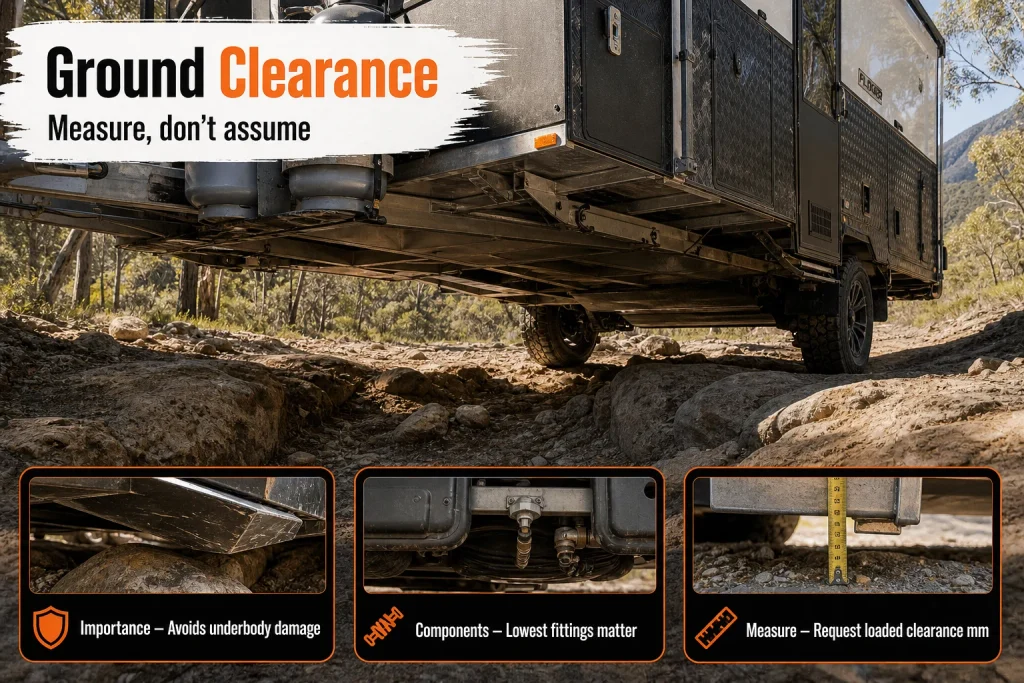
The ground clearance of a caravan determines whether the caravan can pass over ruts, rocks, and uneven sections without damaging components underneath.
While a caravan may appear high off the ground, plumbing, tanks or stabiliser legs may be placed much lower.
What Should You Measure?
You should ask for actual measurements instead of descriptions such as high clearance.
Measurement
Why It Matters
Minimum loaded ground clearance (mm)
Shows the distance beneath the lowest vulnerable component
Chassis clearance (mm)
Helps assess clearance beneath the main structure
Rear overhang (mm)
Influences the risk of scraping on steep transitions
Departure angle (degrees)
Indicates how easily the rear may contact the ground
Consider two hypothetical caravans:
● Minimum loaded clearance of 220 mm for caravan A.
● Minimum loaded clearance of 300mm for caravan B.
Caravan B has 80 mm more clearance at its lowest measured point, which may be helpful when crossing certain obstacles.
The comparison is meaningful only if both measurements are made using the same method and loading condition. In case of a steep departure, if caravan B has a long rear overhang, it might scrape.
Standard vs Full Off-Road Ground Clearance
A standard off-road caravan may have enough clearance to fit through formed dirt roads and maintain campsite entrances.
To improve suitability for uneven terrain, off-road caravans often position tanks and other components higher or protect them more extensively.
It is important to compare the lowest loaded clearance and departure angle, and not simply the chassis height.
Chassis Construction: Does Stronger Mean Better?
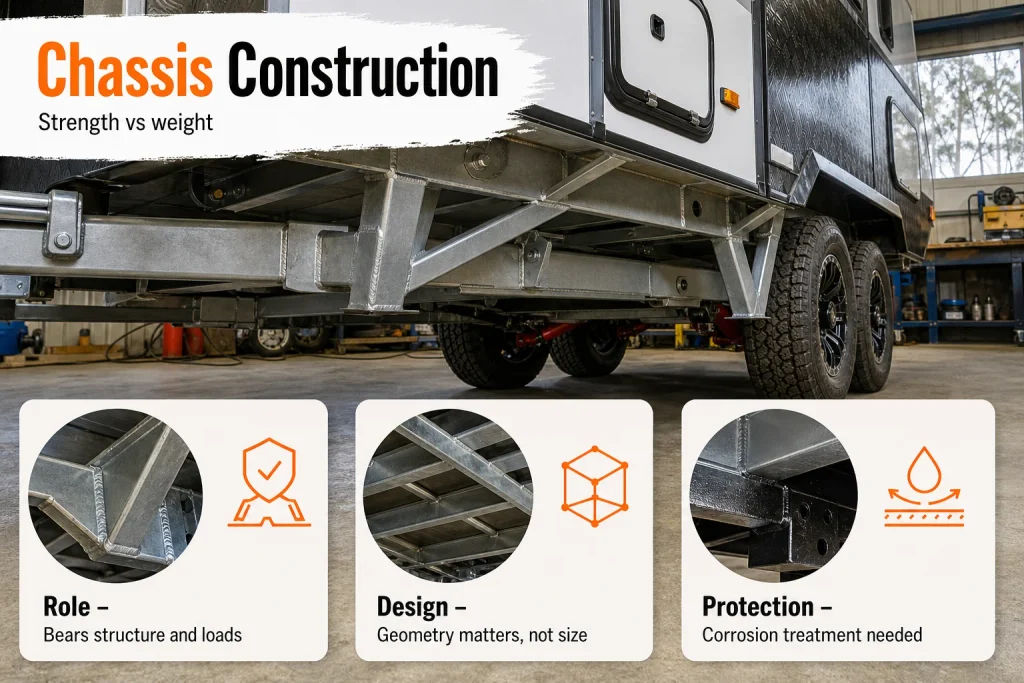
As well as bearing the caravan’s structural loads, the chassis also connects the body, suspension, and towing equipment.
In rough-road travel, repeated vibration, twisting, and impact loads are introduced, making chassis design particularly important.
Standard Off-Road Caravan Chassis
Off-road caravans may use conventional chassis designs with reinforcements.
With these, you can strike a balance between strength, weight, and daily touring needs.
Full Off-Road Caravan Chassis
Off-road caravans usually feature heavier-duty structural components, additional bracing, and reinforced suspension mounting points.
Comparing chassis specifications should focus on measurable details rather than general terms such as heavy duty. To structure your checks, use a practical caravan buying checklist.
Chassis Specification
What Buyers Should Check
Main rail dimensions
Published height, width and wall thickness
A-frame construction
Material, dimensions and reinforcement
Suspension mounting
Reinforcement and load distribution
Corrosion protection
Galvanising or other protective treatment
Rated mass
Compatibility with the caravan’s ATM and axle ratings
As an example, a manufacturer may advertise chassis with 150 mm-deep main rails. It’s useful information, but it’s not sufficient to establish strength based on rail depth alone.
As well as steel grade and wall thickness, crossmembers, welds, chassis geometry, and engineering design contribute to structural performance. Learn more about modern materials and builds in our overview of aluminium frame caravans.
A heavier or taller chassis does not always add to the payload capability of the caravan, especially if the additional weight reduces its load capacity.
Takeaway: Be sure to compare complete chassis engineering as well as rated loads, not just rail dimensions.
Underbody Protection and Off-Road Couplings
A vehicle’s suspension and chassis are important, but exposed components can still suffer damage.
Underbody Protection
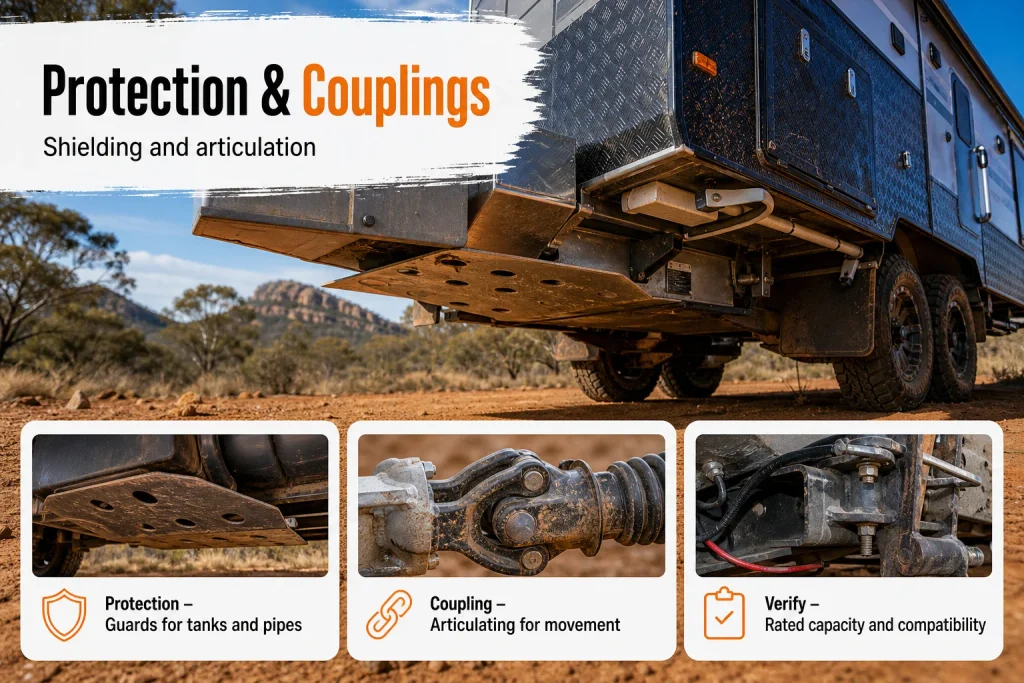
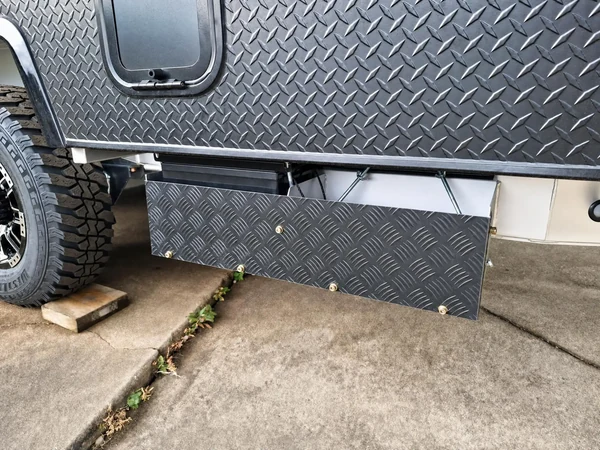
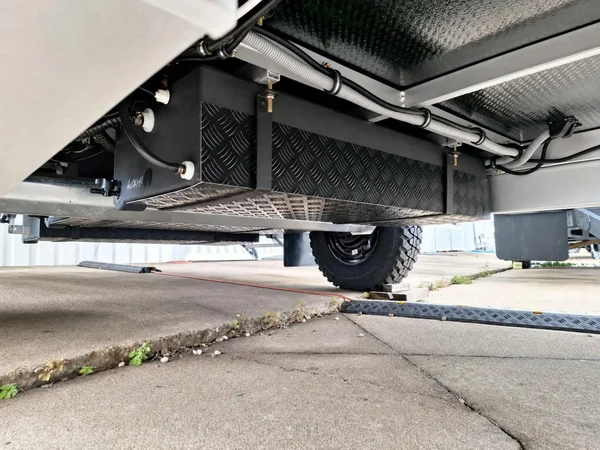
The loose stones and uneven surfaces can damage water tanks, plumbing, electrical wiring and other exposed fittings.
A standard off-road caravan may include stone guards and protective covers.
Off-road caravans often provide more comprehensive shielding and better placement of components.
You should check whether the following are protected:
● Fresh-water and grey-water tanks.
● Exposed water pipes and fittings.
● Electrical wiring and connectors.
● Brake lines and suspension components.
● Rear stabiliser legs and steps.
Coupling Articulation
It is necessary for a caravan coupling to safely accommodate movement between the tow vehicle and caravan.
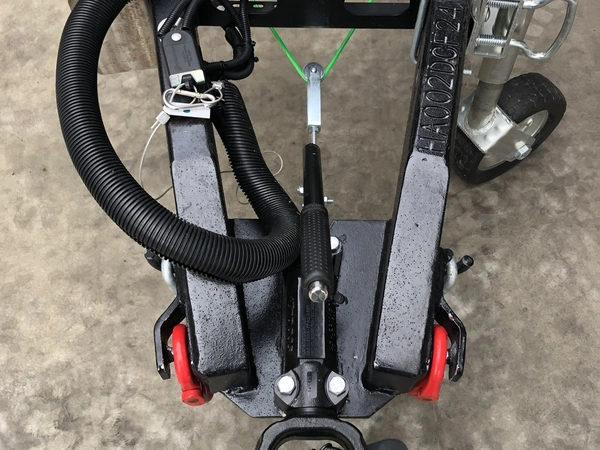
In full off-road caravans, articulating couplings are commonly used since they allow greater movement over uneven terrain.
Comparing couplings, confirm their rated capacity, compatibility with the tow vehicle, and approved operating conditions.
Increased coupling articulation does not increase the caravan’s ground clearance or make an unsuitable track safe.
Which Terrain Can Each Caravan Handle?
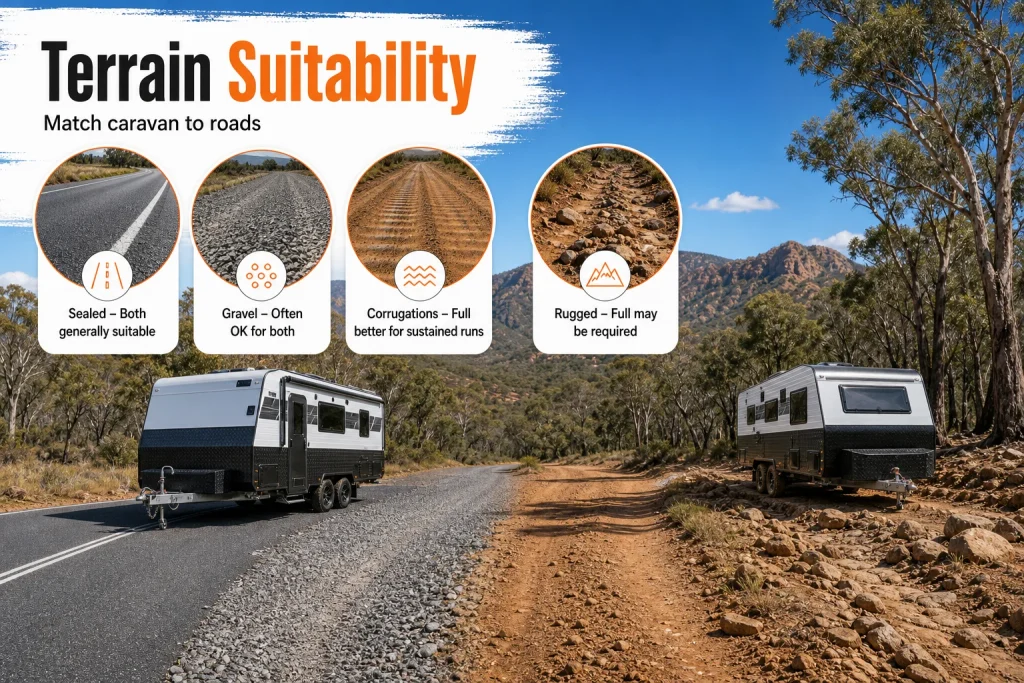
There are several important differences between standard and full-off-road caravans when it comes to their terrain suitability.
Terrain
Standard Off-Road
Full Off-Road
Sealed highways
Generally suitable
Generally suitable
Maintained gravel roads
Often suitable
Often suitable
Formed dirt campsite roads
Often suitable
Often suitable
Light corrugations
Depends on model and conditions
Depends on model and conditions
Extended heavy corrugations
May exceed intended use
More likely to be designed for these conditions
Rocky or deeply rutted tracks
Generally limited
Potentially suitable within manufacturer limits
Steep washouts
Clearance and geometry dependent
Clearance and geometry dependent
Deep water crossings
Not assumed suitable
Not assumed suitable
A general comparison rather than a rating of terrain is presented in the table below.
While a full off-road caravan may be better suited for sustained corrugations, it is not automatically suitable for all 4WD tracks.
As well as road restrictions, weather, loaded weight, tyre condition, and tow vehicle capability must be taken into consideration. Planning trips in Queensland or Western Australia? Conditions there vary widely across regions.
Trip A: Highway Touring with Gravel Roads Occasional
For most of the trip, travelers travel on sealed highways, using maintained gravel roads to reach established campsites along the way.
A suitable off-road caravan may be able to provide the required capability without adding unnecessary weight. If you’re based in Victoria, compare off-road caravans in Victoria.
Frequent remote and rough-road touring on Trip B
There is another traveller who uses remote unsealed roads, encounters extended corrugations, and accesses campsites over uneven ground.
It may be safer and more suitable to use an off-road caravan engineered by a manufacturer who approves those conditions. Remote routes in the Northern Territory often demand this level of build and clearance.
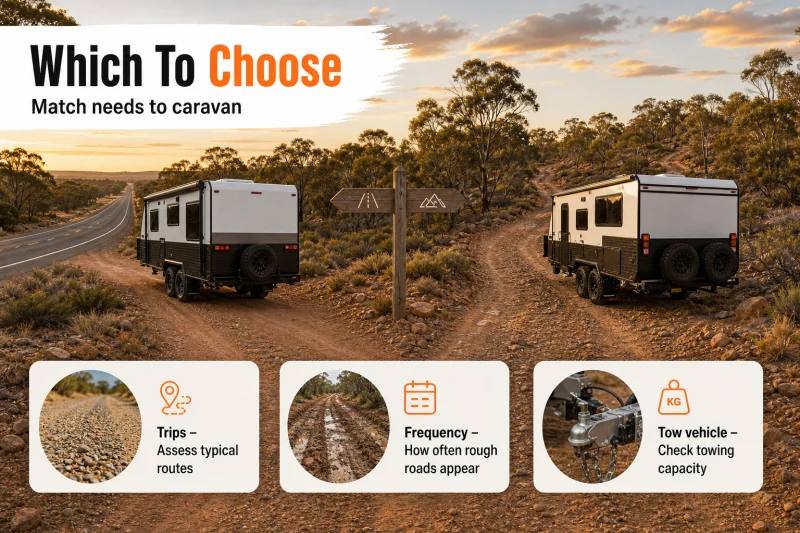
A difference does not simply lie in the destination. In other words, it is the frequency, severity, and duration of the road conditions encountered.
Caravan Weight and Payload: The Numbers Buyers Should Compare
Off-road caravans may include additional structural reinforcement, suspension components, and protective equipment.
Although actual weights vary greatly between models, these features can increase tare mass.
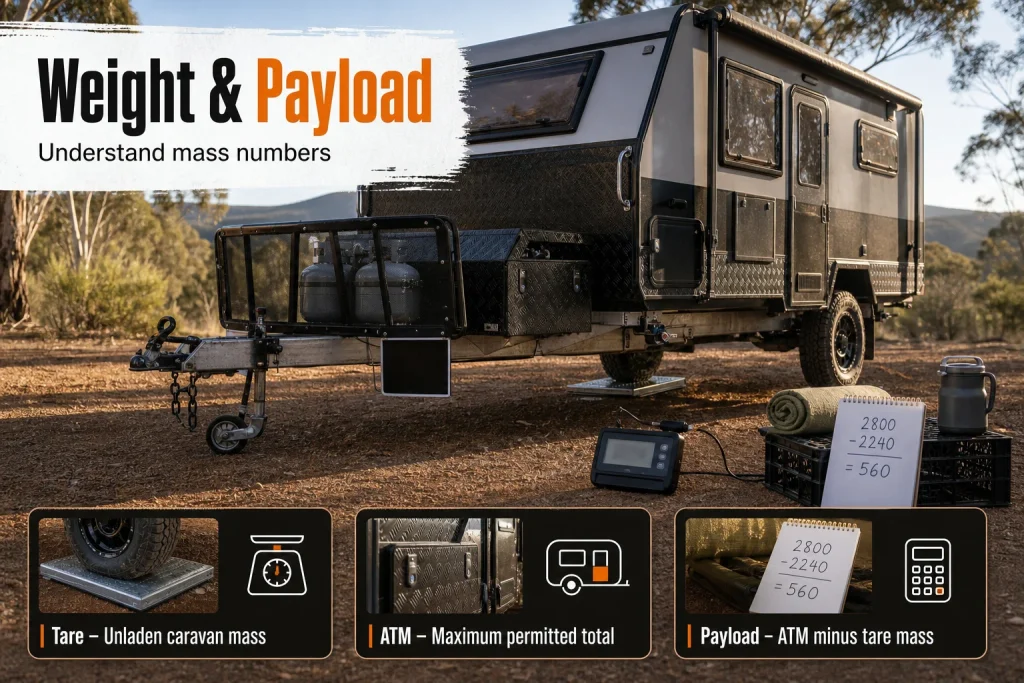
To help determine whether a caravan suits your tow vehicle and travel requirements, it is important to understand the caravan’s weight rating. Shoppers aiming to keep weights down can browse caravans under 3,000kg ATM.
Important Caravan Weight Terms
Term
Meaning
Tare Mass
Caravan’s specified unladen mass
ATM
Maximum permitted total loaded caravan mass
GTM
Maximum permitted mass carried through the caravan’s wheels
Payload Capacity
ATM minus Tare Mass
Towball Download
Downward load transferred to the tow vehicle through the coupling
Example: Calculating Caravan Payload
Suppose a caravan has:
● Tare Mass: 2,500 kg
● ATM: 3,000 kg
Its nominal payload capacity is:
3,000 kg − 2,500 kg = 500 kg
There is a 500kg allowance that must accommodate each item added beyond the tare condition, including water, luggage, food and accessories.
For example:
Added Load
Example Weight
180 litres of fresh water
Approximately 180 kg
Luggage and camping equipment
120 kg
Food and supplies
60 kg
Additional accessories
80 kg
Total
440 kg
Using this example, only 60 kg of nominal payload remains.
It should be noted that these are illustrative figures, and not specifications for a particular caravan. The actual tare conditions and installed equipment must be checked.
The payload capacity of a caravan with impressive off-road equipment may make it unsuitable for extended travel.
In addition, you should verify the tow vehicle’s braked towing capacity, towball limit, GVM, GCM, and axle ratings.
Standard Off-Road vs Full Off-Road: Which Should You Choose?
Choosing the right caravan depends on how frequently you travel off sealed roads and what conditions you expect. For an up-to-date model roundup you can consider, see our best off-road caravans.
Choose a Standard Off-Road Caravan If:
● In most cases, trips involve highways or roads that are maintained.
● Gravel-road travel is occasional.
● Generally, you stay at campsites that are well established.
● In terms of towing weight, you prefer a balance between capability and towing weight.
● As far as I know, your intended routes are within the manufacturer’s approved use guidelines.
Choose a Full Off-Road Caravan If:
● There are rough, unsealed roads you travel on regularly.
● It is common for your planned routes to have extended corrugations.
● Suspension needs to be specialised and you need better underbody protection.
● It is a regular part of your travel plans to do remote touring.
● It is possible for your tow vehicle to safely accommodate the caravan’s loaded weight.
Five Specifications to Compare Before Buying
Request these details for each shortlisted caravan before making a decision:
Confirm the suspension system’s load capacity and intended terrain.
Obtain the measurement in millimetres of the minimum loaded clearance.
Specifications for chassis construction: compare rail construction with structural reinforcement.
Calculate ATM minus tare mass and take into account actual touring equipment.
Check the manufacturer’s operating guidance and warranty conditions when operating on approved terrain.
Measurable details make a more reliable comparison than an off-road label alone.
Final Thoughts
A standard off-road caravan or a fully off-road caravan should be selected based on actual engineering specifications and the intended travel conditions.
Off-road models can be useful for highway touring and occasionally maintained gravel roads. Off-road models generally offer more specialised construction for regular rough-road travel.
Be sure to compare suspension ratings, ground clearance, chassis construction, payload, and terrain approved by the manufacturer before you buy. Upgrading from an older rig? You can list it fast through our sell my caravan page.
The best caravan is not necessarily the one with the strongest off-road rating. This is the one whose capabilities, weight, and design fit the journey you intend to take.
Share this article
Frequently asked questions (FAQs)
Ready to Find Your Dream Caravan?
Explore thousands of caravans for sale across Australia and start your journey in style.
Looking to buy? Browse caravans for sale from dealers and private sellers across Australia, with listings available by make, model, price, location and caravan type.
Ready to sell? Visit Sell My Caravan to advertise your caravan for just $49 incl. GST. Your listing stays live until sold, helping you connect with potential caravan buyers across Australia.
Explore Other Travel Options
Still deciding which travel setup suits you? Browse motorhomes for sale for a vehicle with integrated living space, or explore campervans for sale for a more compact option. For a towable camping setup, compare camper trailers for sale across our other marketplaces.
 Off Road Caravan
 2,500 Kg
 19.67 ft (6.0m)