Compare Off Road Caravan Types

Choosing an off road caravan involves much more than deciding how rugged you want your caravan to look. Australian buyers will commonly come across terms such as semi off road, full off road, extreme off road and hybrid, but these labels can mean different things between manufacturers.
There is no single industry-wide classification that automatically guarantees how or where a caravan can be used. Instead, the best way to compare off road caravan types is to look at the caravan’s intended use, chassis, suspension, ground clearance, coupling, tyres, protection, weight, payload and off-grid capabilities.
This guide explains the main types of off road caravans in Australia, their typical differences and which type may suit your tow vehicle, destinations and style of travel.
Off Road Caravan Types at a Glance
While manufacturers may use slightly different terminology, most off road caravans can broadly be compared across four common categories.
| Caravan Type | Typically Best For | Terrain | Off-Grid Capability | Main Advantage | Main Consideration |
|---|---|---|---|---|---|
| Semi Off Road | Touring with occasional unsealed roads | Bitumen, gravel and maintained dirt roads | Moderate | Lower weight and cost | Less suited to sustained rough terrain |
| Full Off Road | Outback and remote touring | Corrugations and rough unsealed roads | High | Strong balance of durability and comfort | Usually heavier and more expensive |
| Extreme Off Road | Serious remote-area touring | More demanding remote terrain | Very High | Maximum durability and self-sufficiency | Higher weight, cost and tow-vehicle requirements |
| Hybrid Off Road | Compact adventure touring | Gravel, rough roads and remote tracks | High | Compact size and manoeuvrability | Less internal living space |
The important point is that the name alone should never determine your decision. Two caravans both marketed as “full off road” can have very different suspension systems, payloads, construction methods and manufacturer limitations.
Use the categories below as a starting point, then compare the actual specifications of every caravan you are considering.
Semi Off Road Caravans
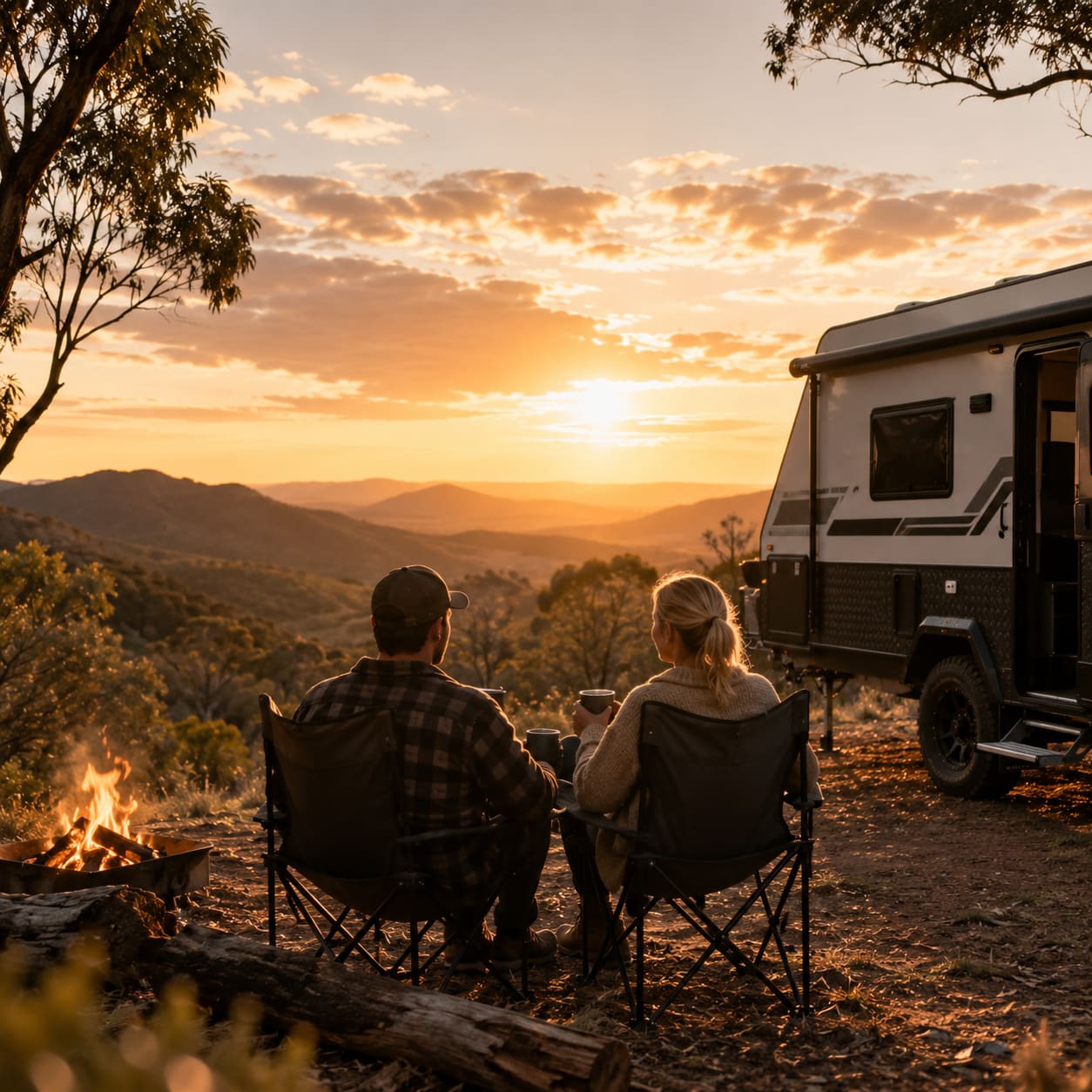
A semi off road caravan is a caravan positioned in the market above a standard touring caravan but below a fully built off road caravan.
These caravans are generally designed for travellers who primarily travel on sealed roads but want a caravan that can handle gravel roads, well-maintained unsealed roads and accessible bush camps in better condition than a conventional caravan.
They commonly include some off-road-oriented upgrades — such as improved suspension, extra ground clearance or all-terrain tyres — while retaining a layout and price point designed for mainstream touring.
Who Is a Semi Off Road Caravan Best For?
A semi off road caravan may suit you if your trips involve:
- Bitumen highways with occasional gravel sections
- Well-maintained dirt roads leading to popular campsites
- Accessible national park roads
- Regularly serviced outback routes
- Occasional bush camps with basic tracks
They are popular with buyers who want more capability than a conventional touring caravan but do not need the weight, cost or engineering of a fully rated off road model.
Typical Semi Off Road Features
Depending on the manufacturer and model, you may find a combination of these upgrades:


The presence of these features does not guarantee off-road performance. Always check the manufacturer’s intended-use statement.
What to Check Before Buying a Semi Off Road Caravan
Ask the manufacturer or dealer:
- Which roads and terrain is this caravan designed for?
- Are there any terrain restrictions in the warranty?
- What suspension system is fitted and what is its rating?
- What is the ATM and how much usable payload is available?
- Does this caravan have an off-road coupling or a standard ball coupling?
- What is the tow-ball weight at ATM?
The last question is particularly important if you intend to tow on rough roads, because suspension and chassis ratings can vary significantly between models marketed with the same category label.
Full Off Road Caravans
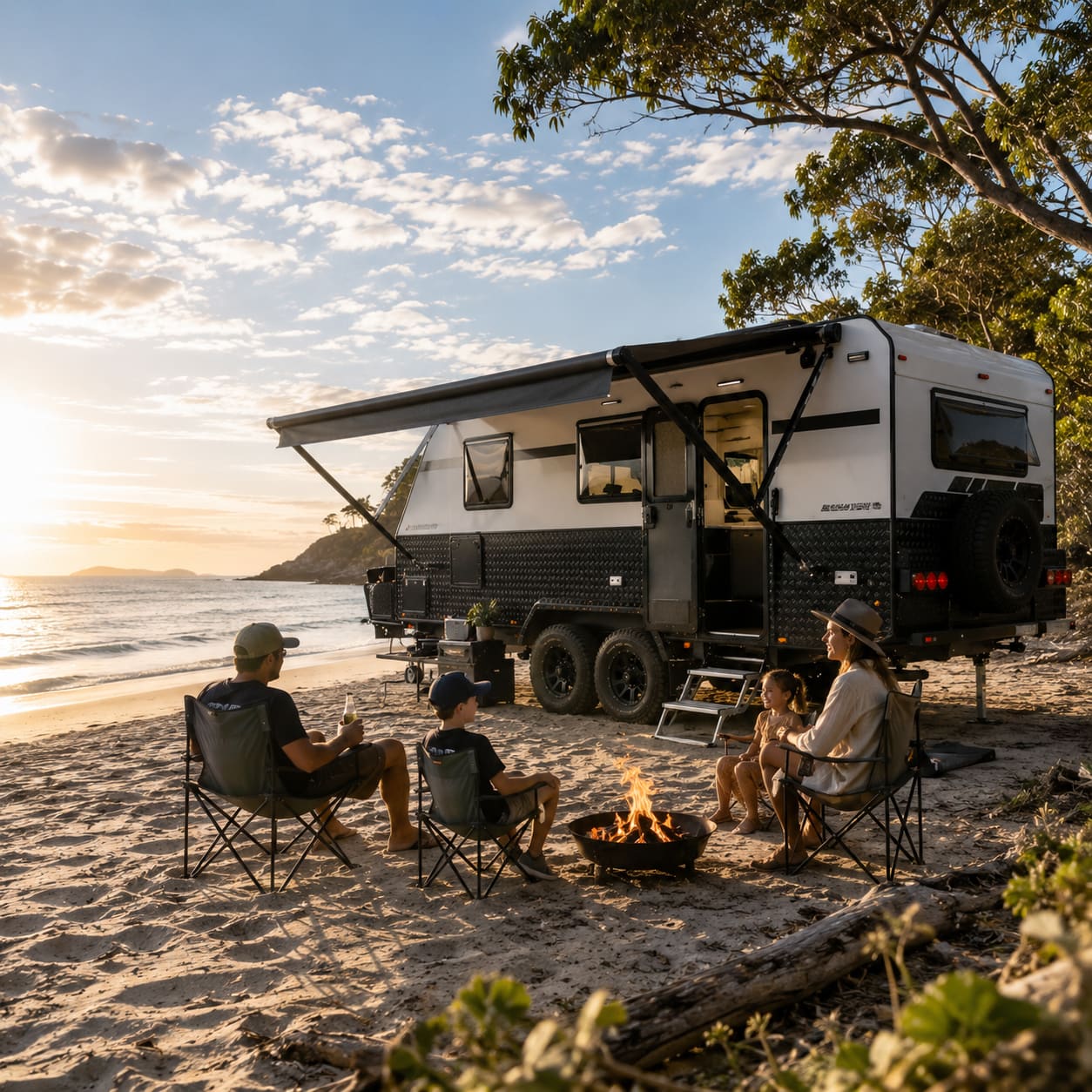
A full off road caravan is generally designed for travellers who expect to spend considerably more time away from sealed highways.
These caravans commonly combine stronger construction with suspension designed for rougher roads, increased ground clearance, off-road couplings, all-terrain tyres and additional protection for components exposed underneath the caravan.
They also frequently include larger electrical and water systems because the destinations they are designed to reach may have limited access to mains power, water or established campgrounds.
Who Is a Full Off Road Caravan Best For?
A full off road caravan may be suitable if you regularly plan to travel on:
- Corrugated Outback roads
- Rough unsealed roads
- Remote touring routes
- Station tracks
- National park access roads
- Extended routes where services are limited
They are particularly popular with travellers who want to explore remote areas while retaining the comfort of a conventional caravan, including an internal kitchen, shower, toilet, large bed and substantial storage.
Typical Full Off Road Features
Depending on the caravan, you may find:

A long specification list does not automatically make one caravan better than another. What matters is how the entire caravan has been engineered to work together.
Full Off Road Does Not Mean “Go Anywhere”
It is important not to assume that a caravan marketed as full off road can follow a 4WD across every type of terrain.
- A caravan remains significantly longer, wider and heavier than the tow vehicle.
- Deep washouts, steep creek crossings, tight tracks and soft sand can still exceed the caravan’s capability.
- Severe angles and extreme terrain may damage even a full off road caravan.
Always check the manufacturer’s intended-use statement and warranty conditions for the exact caravan you are considering before travelling on difficult terrain.
Extreme Off Road Caravans
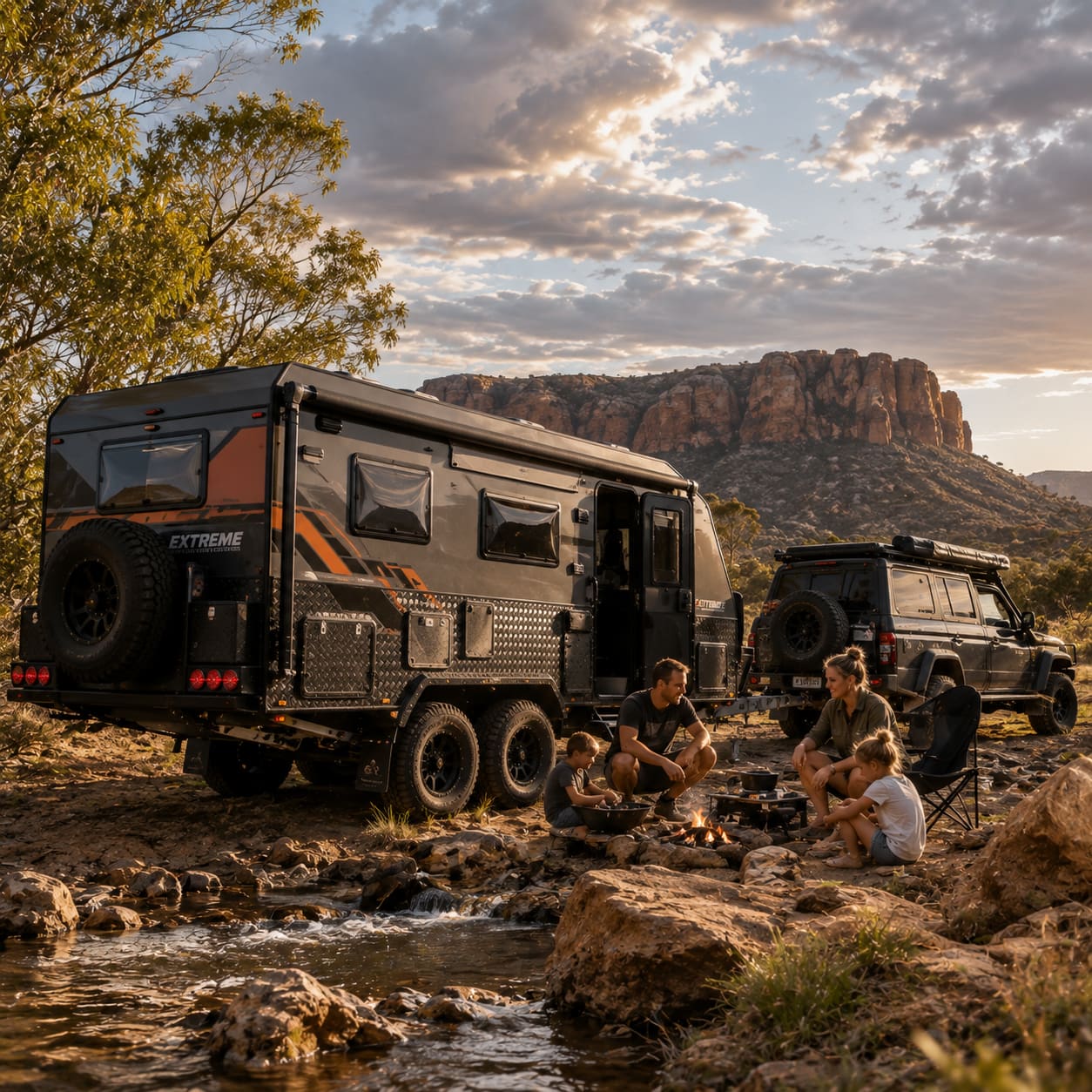
The term extreme off road caravan is generally used for caravans positioned toward the highest end of remote touring capability.
It is not a formal engineering classification. Instead, manufacturers commonly use the term for caravans incorporating more substantial chassis, suspension, protection, payload and off-grid systems designed around extended travel in remote parts of Australia.
These caravans may carry significantly larger quantities of water, electrical storage, solar capacity and equipment than more conventional caravans.
Who Is an Extreme Off Road Caravan Best For?
An extreme off road caravan is most relevant to travellers who:
- Regularly undertake extended remote-area trips
- Expect sustained travel on difficult corrugated roads
- Spend long periods away from powered sites
- Require substantial water and battery capacity
- Carry significant tools, recovery gear and equipment
- Own a suitably rated tow vehicle
For travellers who primarily visit caravan parks and maintained campsites, this additional capability may provide little practical benefit while increasing purchase price and towing weight.
Typical Extreme Off Road Features
Features may include:

Consider the Additional Weight
Extreme off-road capability often adds significant weight:
- A larger chassis, additional batteries and extra water capacity can significantly increase the caravan’s tare.
- Multiple spare wheels, protection systems and recovery equipment increase the Aggregate Trailer Mass.
- Additional weight can also change which tow vehicle you require.
Do not choose the most extreme caravan simply because it appears more capable. Choose the caravan whose capability matches the travelling you actually intend to do.
Hybrid Off Road Caravans
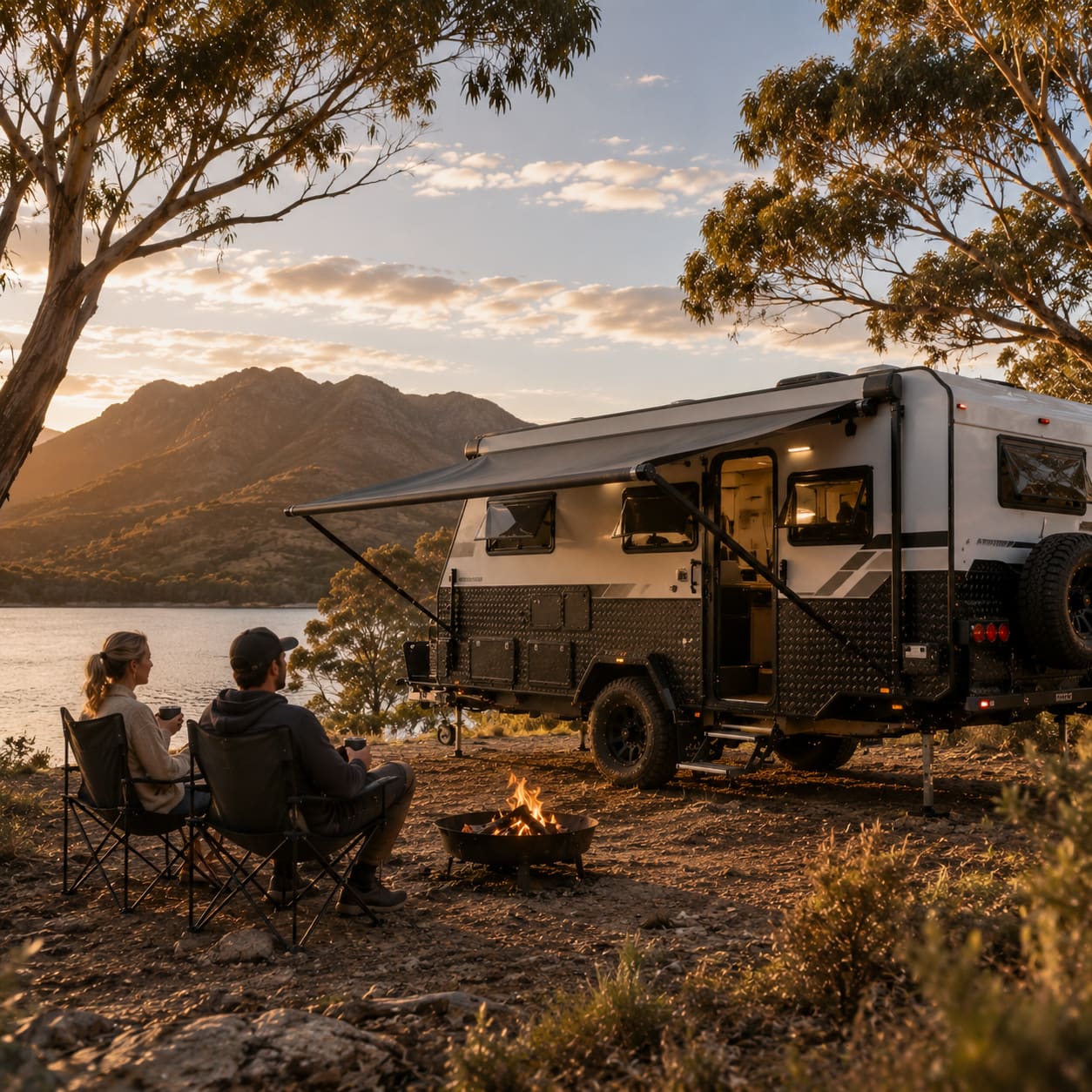
A hybrid off road caravan combines characteristics of an off-road camper trailer with the hard-sided accommodation and amenities normally associated with a caravan.
There is no single universal definition of a hybrid caravan. In practice, hybrids are generally more compact than conventional full-size caravans and are designed to provide strong off-road capability while reducing overall towing dimensions.
Some use pop-top roofs, while others use full-height bodies. Kitchens may be internal, external or a combination of both.
Who Is a Hybrid Off Road Caravan Best For?
Hybrid caravans are particularly attractive to travellers who want:
- A shorter, more compact caravan
- Easier manoeuvrability on tight tracks
- A narrower towing profile
- Strong off-road capability
- Lower overall towing bulk
- Hard-sided accommodation with good off-grid systems
They can work especially well for couples and smaller families who prioritise where they can travel over having maximum internal floor space.
Typical Hybrid Off Road Features
Depending on the model, a hybrid may include:

What Are the Compromises?
Compact size brings advantages, but there may also be trade-offs. Compared with a 20ft–22ft full-size caravan, a hybrid may offer:
- Less internal floor space and smaller bathrooms
- Less internal storage capacity
- External cooking on some models
- Additional setup steps with pop-top designs
- Fewer large family layouts
The decision comes down to whether you value compact towing and manoeuvrability more highly than internal living space.
Key Comparisons
Semi Off Road vs Full Off Road Caravans
One of the most common questions Australian buyers ask is whether they actually need a full off road caravan. The answer depends mainly on where you intend to travel.
| Feature | Semi Off Road | Full Off Road |
|---|---|---|
| Sealed Highways | Excellent | Excellent |
| Formed Gravel Roads | Generally Suitable | Suitable |
| Maintained Dirt Roads | Generally Suitable | Suitable |
| Corrugated Remote Roads | ~Limited / Model Dependent | Generally Better Suited |
| Heavy-duty Suspension | ~Sometimes | Common |
| Off-road Coupling | ~Model Dependent | Common |
| Large Off-grid Electrical | ~Optional / Model Dependent | More Common |
| Larger Water Capacity | ~Model Dependent | More Common |
| Weight | Generally Lower | Generally Higher |
| Purchase Price | Generally Lower | Generally Higher |
If most of your trips involve highways with occasional gravel-road access to campsites, a semi off road caravan may be all you need.
If your travel plans regularly include long corrugated routes, remote touring and extended periods away from services, a full off road caravan is likely to provide a more appropriate starting point.
Full Off Road vs Hybrid Off Road Caravans
A full off road caravan and a hybrid caravan can both be highly capable away from sealed roads, but they generally prioritise different things.
- Internal living space
- Storage
- Larger kitchens
- Larger bathrooms
- Family-friendly layouts
- Residential-style comfort
- Shorter dimensions
- Lower towing profile
- Manoeuvrability
- Access to tighter campsites
- Potentially lower towing weight
- Compact remote touring
Neither is automatically more capable.
The better choice depends on the individual caravan’s engineering and whether you value internal comfort or compact mobility more highly.
What Actually Makes an Off Road Caravan Different?
Rather than judging a caravan by its marketing category, compare the components that determine how it performs.
Chassis & Construction
The chassis forms the structural foundation of the caravan. Off-road caravans commonly use chassis designed to handle increased loads and repeated vibration associated with rough-road travel.
When comparing caravans, consider: chassis material, dimensions, reinforcement, A-frame construction, body construction, mounting method and protection against corrosion.
Do not assume the heaviest chassis is automatically the best. Good engineering balances structural strength with overall caravan weight.
Suspension
Suspension is one of the most important differences between touring and off-road caravans. Systems may include leaf springs, independent coil suspension, independent airbag suspension and trailing-arm systems.
Independent suspension can provide greater wheel movement over uneven surfaces and allow each wheel to react independently.
Suspension should never be assessed in isolation. Its rating, geometry, shock absorbers, brakes, tyres and chassis must work together.
Ground Clearance
Ground clearance helps protect vulnerable components when travelling over uneven terrain. Look carefully at the lowest points underneath the caravan, including water tanks, plumbing, steps, spare-wheel mounts, suspension components and stabilisers.
A caravan may appear tall while still having vulnerable components mounted relatively low.
Off Road Coupling
An off-road articulation coupling is designed to allow greater movement between the caravan and tow vehicle than a conventional ball coupling. This becomes particularly important when the tow vehicle and caravan are travelling across uneven terrain at different angles.
Check both the coupling type and its rated capacity.
Tyres & Wheels
Off-road caravans commonly use stronger tyres with increased sidewall height and tread designed for unsealed surfaces. Check tyre load rating, wheel size, spare-wheel availability, compatibility with the tow vehicle where relevant and accessibility of replacements in remote areas.
Dust & Water Protection
Dust ingress can become a significant issue during extended travel on dry, corrugated roads. Look for quality door and hatch seals, protected vents, pressurisation or dust-reduction systems, protected plumbing, protected water tanks and sealed electrical components.
Water crossings require additional care because the capability and permitted use of individual caravans varies substantially.
Compare Off Road Caravan Weight and Towing Requirements
Off road caravans can become considerably heavier as more equipment is added. Before choosing a caravan, understand its Tare Mass, Aggregate Trailer Mass, payload, tow-ball load and axle rating.
What Is Aggregate Trailer Mass?
Aggregate Trailer Mass (ATM) is the maximum permitted mass of the fully loaded caravan when it is not connected to the tow vehicle.
Your caravan must remain within its ATM when loaded for travel.
What Is Caravan Payload?
Payload is broadly the amount of weight available for your belongings and equipment after accounting for the caravan’s base tare mass. This can be consumed quickly by water, batteries, solar upgrades, additional gas bottles, tools, generators, food, clothing, bikes and camping equipment.
Remote touring often requires carrying more equipment, which makes payload particularly important when comparing off road caravans.
Match the Caravan to Your Tow Vehicle
Never choose a caravan based only on the tow vehicle manufacturer’s headline towing-capacity figure. You also need to consider the complete combination, including applicable towing capacity, tow-ball capacity, Gross Vehicle Mass, axle limits, Gross Combination Mass, caravan ATM and actual loaded weights.
If you are uncertain, have the proposed vehicle and caravan combination professionally assessed before purchasing.
How Much Off-Grid Capability Do You Need?
Being able to reach a remote campsite is only useful if your caravan can support you once you arrive.
Battery Capacity
Lithium battery systems are becoming increasingly common in off-grid caravans. The amount of storage you need depends on the appliances you want to run and how long you expect to remain away from mains power.
Solar Capacity
Solar panels help replenish energy during extended stays. Consider both the total solar capacity and the charging equipment used to manage it.
Inverter Capacity
If you want to operate 240V appliances away from mains power, compare the inverter output and battery system required to support those appliances.
Water Capacity
Water can become one of the most important limitations during remote touring. Compare fresh-water capacity, drinking-water storage, grey-water storage, tank protection and water monitoring.
Remember that one litre of water weighs approximately one kilogram, so additional water also affects caravan payload.
Which Type of Off Road Caravan Should You Choose?
The best off road caravan is not necessarily the caravan with the highest specification. It is the caravan that matches your actual travel plans.
 Choose a Semi Off Road Caravan if:
Your trips are mainly on sealed roads with occasional gravel, maintained dirt roads and accessible bush camps.
Choose a Full Off Road Caravan if:You expect regular travel on corrugated and rough unsealed roads and want greater durability and off-grid capability.
Choose an Extreme Off Road Caravan if:Remote and demanding touring forms a major part of your travel plans and you require substantial payload, power, water and protection.
Choose a Hybrid Off Road Caravan if:You want strong off-road capability in a more compact package and are prepared to trade some internal living space for easier manoeuvrability.
Off Road Caravan Buyer Checklist
Before purchasing any caravan marketed as semi off road, full off road, extreme off road or hybrid, ask:
These questions are often more useful than simply asking whether a caravan is “full off road”.
Australian Off Road Caravan Market Snapshot


Marketplace statistics are calculated from active off road caravan advertisements on CaravansForSale.com.au. Prices represent advertised asking prices rather than confirmed final sale prices. Data is updated regularly as listings enter and leave the marketplace.
Explore More Off Road Caravan Guides

Best Off Road Caravans 2025: What’s New, Tough, and Worth Your Money
Introduction The demand for find the best off-road caravan is soaring as adventurers seek rugged, reliable, and comfortable homes on wheels. These caravans combine durable construction, smart designs, and modern technology to handle challenging terrain while providing creature comforts for extended trips. Whether exploring remote destinations or national parks, off-road caravans offer the perfect blend […]
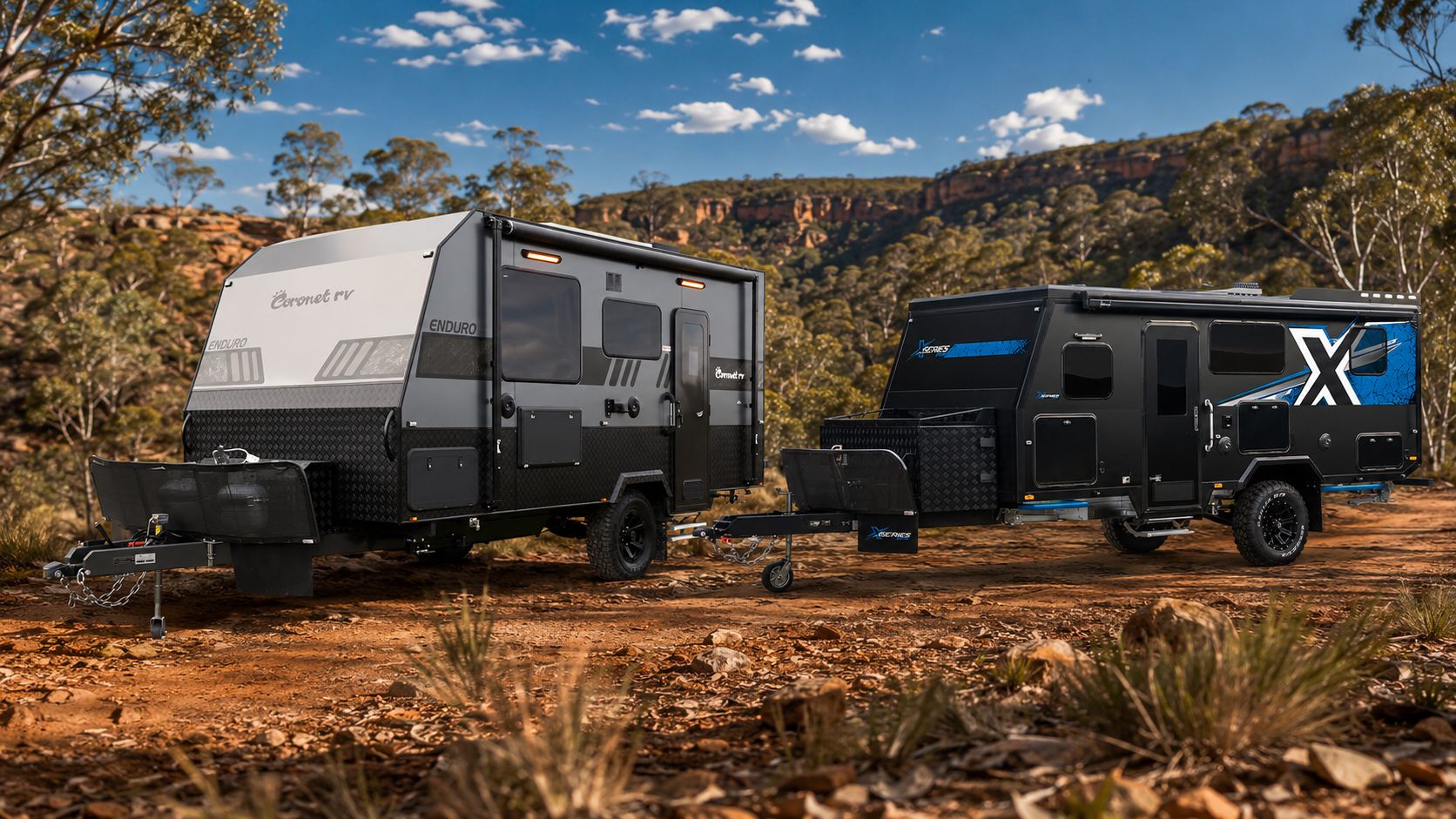
Top 10 Single Axle Off-Road Caravans in Australia – Our Faves
Check out our selection of single axle off-road caravans for the Australian outback. Each one has durability, off-grid features and comfort for the adventurous traveller. From the Gibb Off-Road Plus to the TLCC X-Scape, these caravans have independent suspension, solar power and big interiors for a smooth and comfortable ride. For extended trips these caravans […]
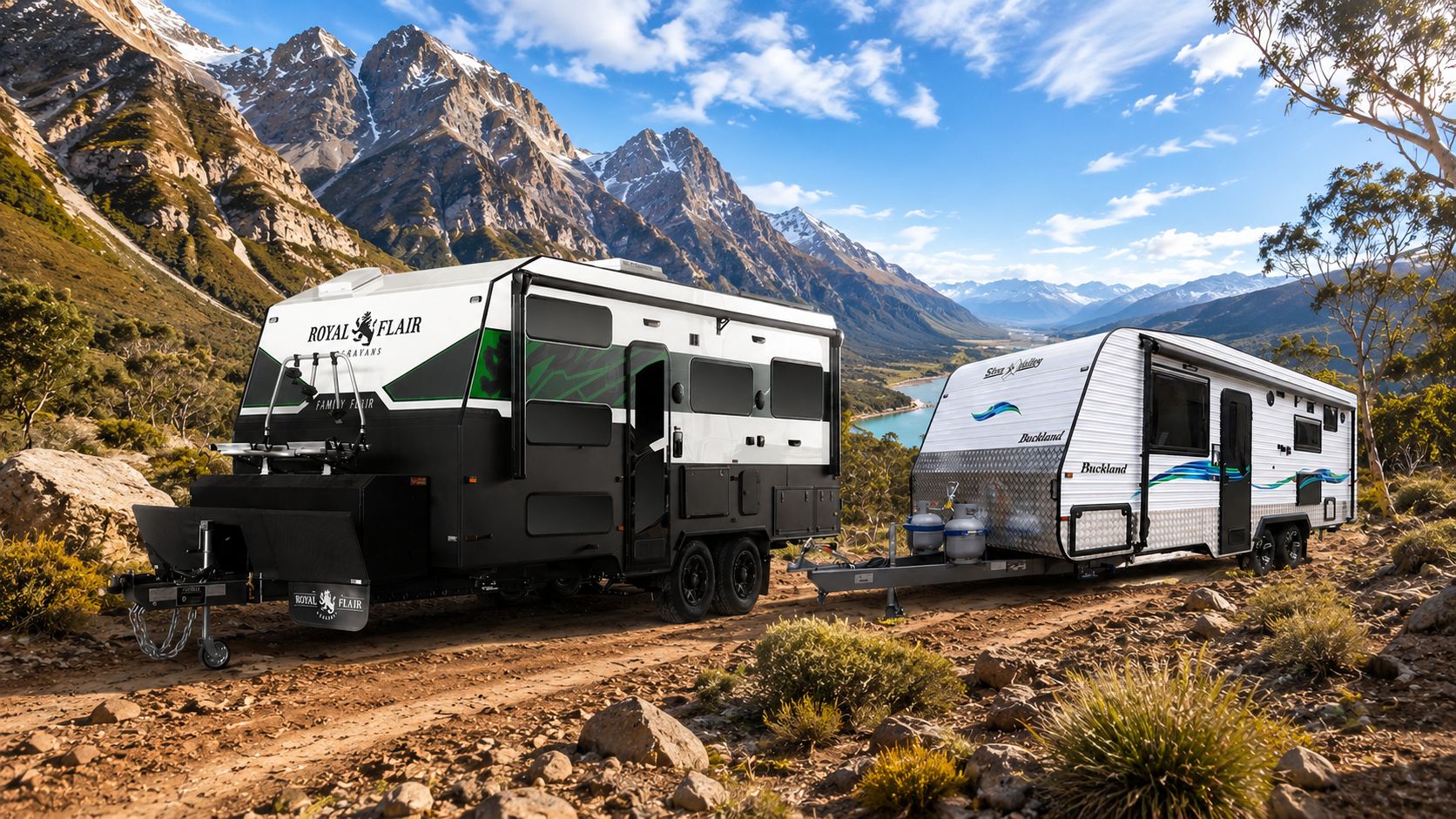
Best 21 ft Off-Road Caravans for Rugged Australian Adventures
So you’re in the market for a 21ft caravan? Well you’re in luck! This blog takes you through some of the best options from renowned caravan manufacturers out there that combine luxury with off-road capability. Whether you’re an adventurer looking for something tough to tackle Australia’s diverse landscapes or a family looking for comfort on […]
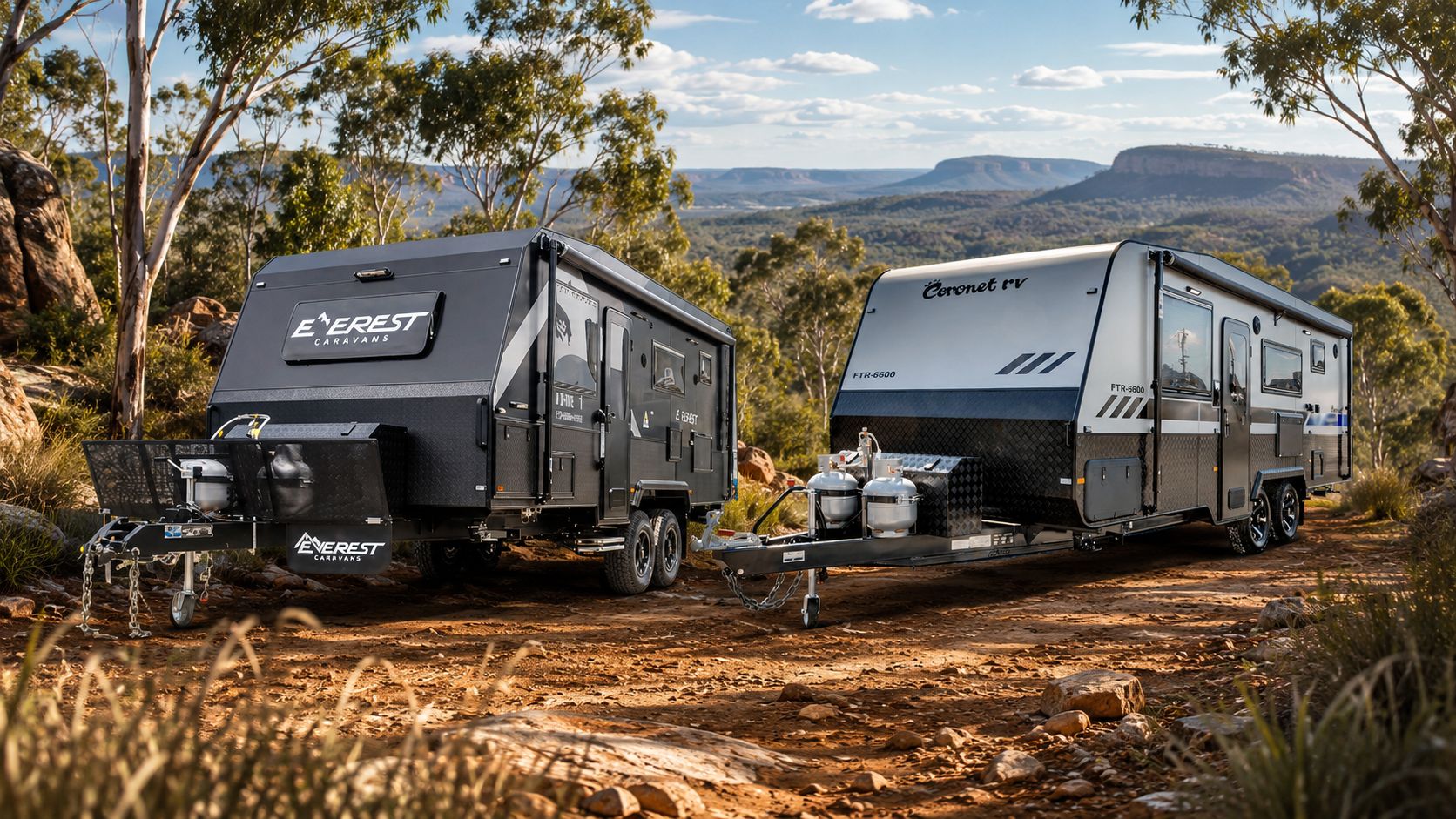
10 Top Family Off-Road Caravans in Australia – Award-Winning Durability & Luxury
Welcome to our family off-road caravan blog for families who want to go on an adventure and be comfortable on the rough Australian outback. Check out 10 caravans from top off-road caravan manufacturers that offer durability and luxury for your next trip. We’ll look at the features that make each model stand out, including big […]

Best Off Road Pop Top Caravans Australia
Australia’s best off road pop top caravans combine a reduced travel height with reinforced chassis, independent suspension and off-grid equipment. Current models range from approximately 1,450kg to 2,460kg tare, with ATMs between 2,000kg and 2,990kg. A lowered roof can reduce frontal area while towing, improve access beneath trees and help some models fit under a […]
Frequently Asked Questions
