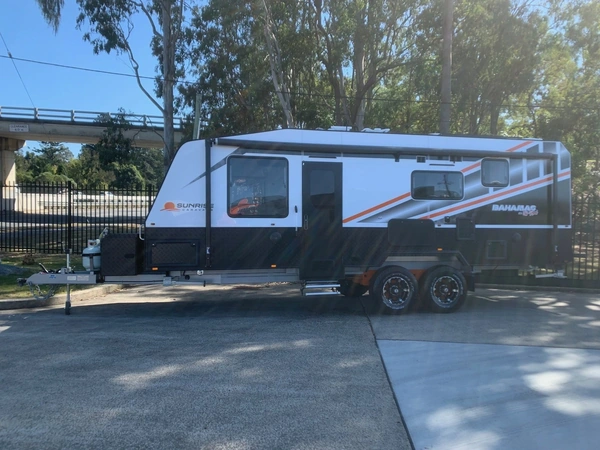
If you’re searching for the best off road caravan for couples Australia has to offer, the right choice depends on how you travel, what your vehicle can tow and how much comfort you want on the road.
Choosing the best off road caravan for a couple is less about finding the smallest two-berth caravan and more about matching the caravan to the way you intend to travel.
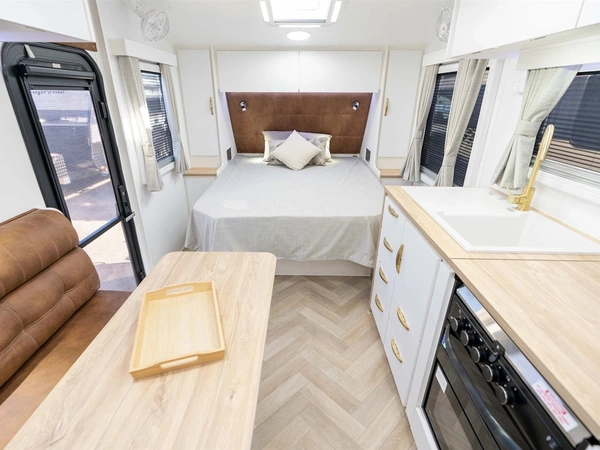
Some couples want a compact off-road caravan that is easier to manoeuvre and better suited to short trips or tighter campsites. Others want a larger caravan with an island bed, full ensuite, washing machine, generous battery capacity and enough storage to comfortably spend weeks or months on the road.
There is plenty of choice in the Australian market. In the CaravansForSale.com.au off-road market data used for this guide, 2-berth caravans accounted for 59.5% of listings with valid sleeping-capacity information, making two-person layouts the most common recorded configuration. Their median advertised asking price was approximately $88,995.
Rather than declaring one caravan universally better than every other option, we have compared current examples across different sizes, weights, layouts and price points to show what may suit different types of travelling couples.
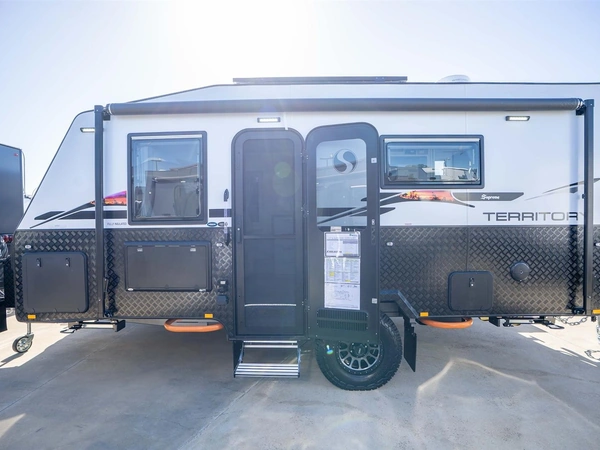
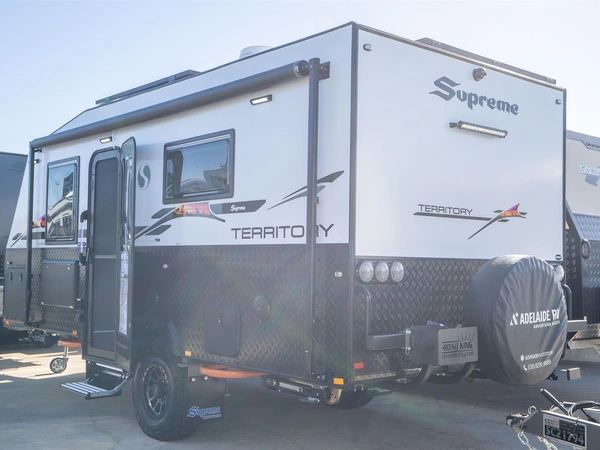
The following caravans illustrate how different an off road caravan for couples can be. The comparison ranges from a 13ft compact touring caravan through to a 22ft premium off-road caravan.
Model
Length
Sleeps
Tare
ATM
Indicative price*
Best suited to
Kokoda C180 XC
18ft
2
Approx. 2,250kg
3,000kg
XC range from $139,000
Couples wanting compact dimensions with substantial off-grid capability
SWAG SCT13 Couples
13ft
2
Approx. 1,975kg
2,500kg
$68,990
Compact touring with substantial off-grid equipment
Crusader Musketeer Camelot
19’3″
2
Approx. 2,182kg
2,800kg
Base RRP $100,608
Couples wanting a single-axle touring layout with full-size facilities
Mars 16 Cruiser FHR – MK4
16ft
2
2,420kg
3,000kg
From $72,990
Compact off-grid touring with a 48V electrical system
Gold Class AC22C
22ft
2+1
Approx. 3,820kg
4,495kg
RRP $184,990
Premium extended off-grid touring where space and equipment are priorities
Lotus Trooper TR21CL
21ft
2
3,125kg
4,495kg
$172,990 asking price
Premium touring where space and equipment matter more than low towing weight
*Specifications and advertised prices were checked against the sources available during the research period. Prices, specifications, options and availability can change. Always confirm the compliance plate and specification of the individual caravan before purchase.
Kokoda C180 XC
For couples wanting a relatively compact Australian-made caravan without giving up the facilities expected for longer touring, the Kokoda C180 XC provides an interesting option.
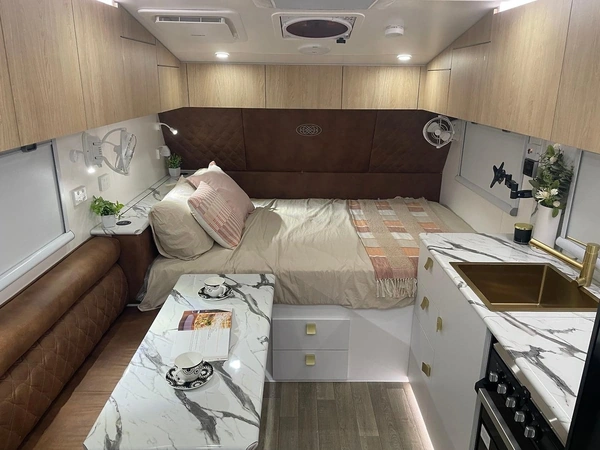
At 18ft, the C180 XC has an approximate tare of 2,250kg and an ATM of 3,000kg. Its couples layout includes a front bedroom with a queen bed, a straight lounge, kitchen with a 274L fridge and a large rear ensuite with shower and toilet. A twin-single-bed configuration is also available.
The XC specification adds equipment intended for longer off-grid travel, including composite sandwich-panel construction, lithium battery capacity, rooftop solar, Victron power management, independent suspension and substantial fresh-water storage.
For couples comparing smaller off-road caravans with more conventional touring facilities, the C180 demonstrates how an 18ft layout can provide a full bedroom, living area, kitchen and ensuite without immediately moving into a 20ft-plus caravan.
SWAG SCT13 Couples
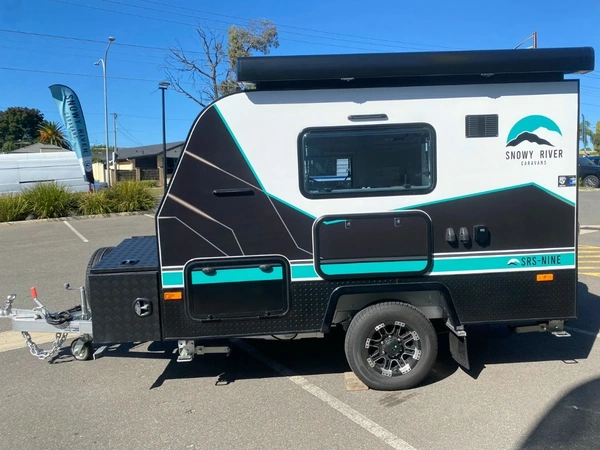
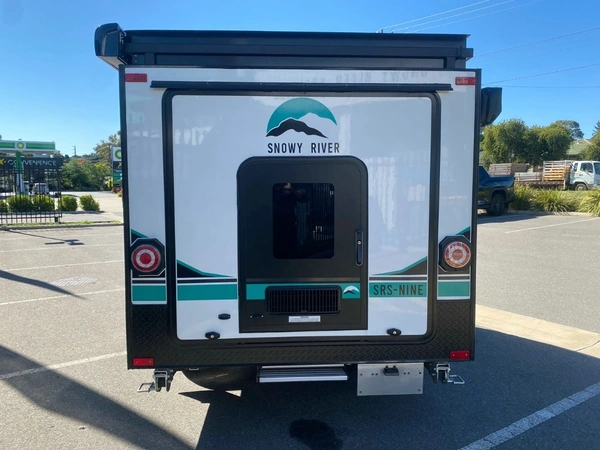
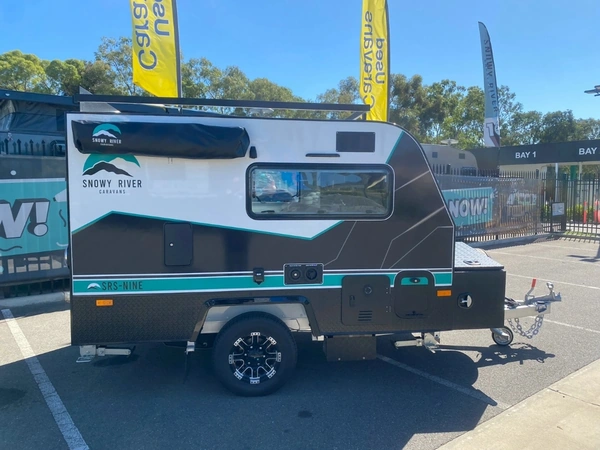
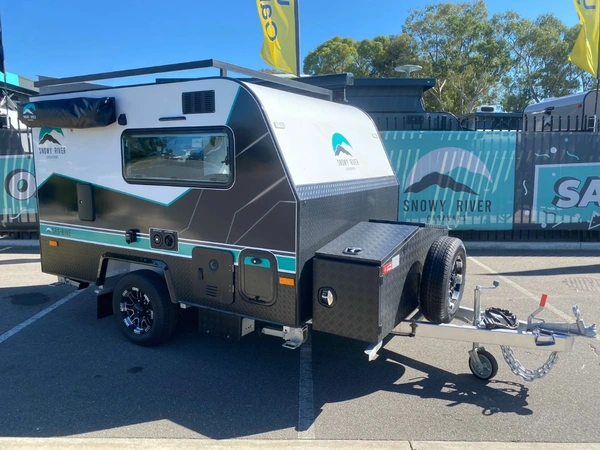
The SWAG SCT13 Couples moves further towards a fully equipped compact touring setup.
SWAG publishes an approximate tare of 1,975kg and ATM of 2,500kg. Despite its 13ft body, the specification includes a north-south king bed, internal combination ensuite and 200 litres of fresh-water capacity.
Its published price at the time of research was $68,990.
For couples wanting a smaller caravan while still prioritising sleeping comfort and off-grid capacity, the SCT13 occupies an interesting middle ground between ultra-compact touring and a conventional full-size caravan.
Crusader Musketeer Camelot
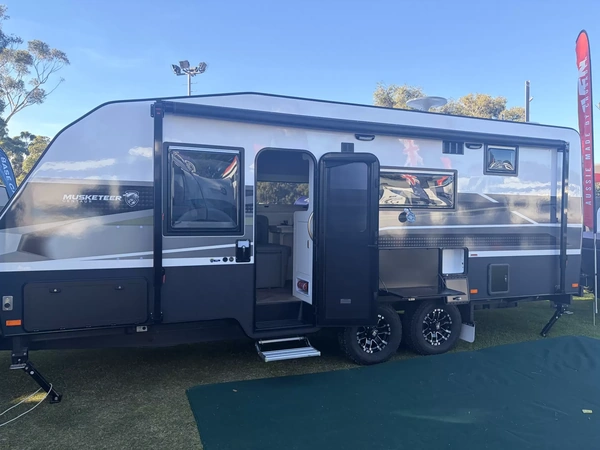
At 19’3″, the Crusader Musketeer Camelot shows how a single-axle couples caravan can combine manageable towing specifications with a more conventional touring interior.
The 2026 model has an average listed tare of approximately 2,182kg and ATM of 2,800kg. It includes a queen bed, café dinette, full ensuite, top-loading washing machine, 224L compressor fridge, independent CrusadAir airbag suspension, 200Ah lithium battery and two 200W solar panels.
The published base RRP at the time of research was $100,608.
For couples comparing off-road caravans, the Camelot is an important example of how floorplan, equipment and towing requirements need to be considered together rather than simply choosing a caravan according to its external size.
Mars 16 Cruiser FHR – MK4
The Mars 16 Cruiser FHR – MK4 represents a compact approach to couples touring while still placing considerable emphasis on off-grid capability.
The 16ft model has a published tare of 2,420kg and ATM of 3,000kg. It includes an extendable island-style queen bed, separate bathroom and shower, built-in washing machine, 200L internal fridge, independent coil-spring suspension with Pedders shock absorbers and dual 120L water tanks.
Its 48V electrical system includes a 7.68kWh battery system, rooftop solar and a 3,000W Victron inverter charger.
The published starting price was $72,990 when researched.
A caravan like this may appeal to couples who want a shorter overall body while still prioritising off-grid electrical capacity, water storage and internal facilities.
Gold Class AC22C
The Gold Class AC22C provides an example of how couples can use additional caravan length and carrying capacity for comfort and extended off-grid capability rather than additional permanent sleeping accommodation.
At 22ft, it has an approximate tare of 3,820kg and a 4,495kg ATM and uses a tandem-axle configuration with Airbag Man suspension. Its interior includes a queen island bed, rear club lounge, full ensuite, dishwasher and premium kitchen facilities.
Its off-grid specification includes 1,380Ah of lithium battery capacity, 2,090W of rooftop solar, a 3,000W inverter charger and 320 litres of fresh-water capacity.
The published RRP at the time of research was $184,990.
For two people travelling for longer periods, the appeal of a layout such as this is that additional floor space and payload can be dedicated to living, dining, storage, bathroom facilities and substantial off-grid systems instead of bunks.
Lotus Trooper TR21CL
At the larger and more premium end of the researched examples is the Lotus Trooper TR21CL.
The 21ft listing recorded a 3,125kg tare and 4,495kg ATM, with an advertised asking price of $172,990.
It is a useful example because it shows just how widely towing requirements can vary among caravans that still only sleep two people.
A premium 20ft-plus couples caravan may offer significant interior space and equipment, but the tow vehicle requirements can be completely different from those of a smaller compact caravan.
Compare current two-person off road caravans available across Australia, including compact, mid-size and larger touring models.
Compact off-road caravans can make considerable sense for two people.
A couple does not need bunks, multiple dinettes or sleeping accommodation for four, five or six people, allowing manufacturers to concentrate the available space on a permanent bed, bathroom, kitchen and storage.
Among the current examples researched, the 13ft SWAG SCT13, 16ft Mars 16 Cruiser FHR – MK4 and 18ft Kokoda C180 XC demonstrate three quite different approaches to more compact couples touring.
The SWAG uses its compact footprint to provide a king bed, ensuite and substantial water capacity. The Mars combines a 16ft body with a separate bathroom, island-style queen bed and 48V off-grid electrical system. The Kokoda moves into a more conventional 18ft caravan layout with a front bedroom, living area, kitchen and large rear ensuite.
That last point is particularly important for buyers searching for the best small off road caravan for couples.
Compact and lightweight are not the same thing.
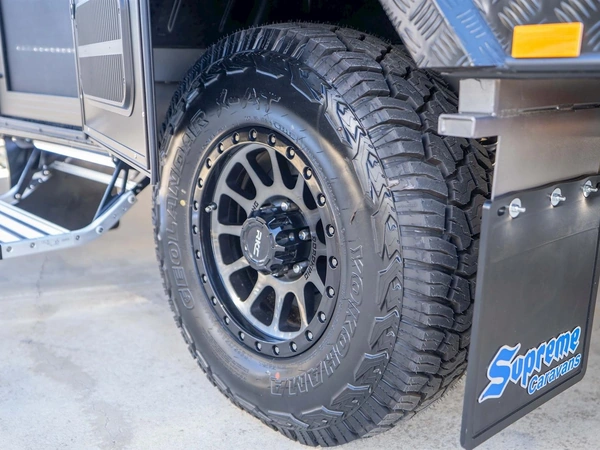
A short caravan with heavy-duty suspension, batteries, water tanks, off-road tyres, a stronger chassis and extensive equipment may weigh considerably more than its external dimensions suggest.
What Makes a Good Off Road Caravan for a Couple?
The right caravan for two people depends on how those two people intend to use it.
For weekend trips, a compact layout with a smaller bathroom and limited internal seating may be perfectly adequate. For a couple travelling around Australia for several months, the priorities can change substantially.
A permanent bed becomes more valuable when it does not need to be converted into seating every day. A north-south or island bed can also make it easier for either person to get in and out without climbing over the other.
Bathroom layout matters for the same reason. A combination shower and toilet saves considerable space, while a separate shower and toilet generally requires a larger caravan but may be more comfortable during extended travel.
Kitchen bench space, refrigerator capacity and internal seating can become increasingly important the longer the caravan is used as a living space rather than simply somewhere to sleep.
Storage should also be considered carefully. Two people may not require family-sized sleeping accommodation, but long-distance travellers can still carry substantial clothing, food, tools, outdoor equipment and spare parts.
And for couples planning remote travel, water, batteries, solar capacity and electrical management can be just as important as the floorplan itself.
What Size Off Road Caravan Is Best for Couples?
There is no technically correct caravan length for two people.
The current Australian off-road marketplace is heavily represented by larger caravans. In the market data researched for this guide, caravans from 18–20ft represented 26.4% of listings with valid length data, while 20–22ft accounted for 27.1%. Caravans under 16ft represented only 9.7%.
That does not mean larger caravans are automatically better for couples. It simply shows where current advertised inventory is concentrated.
13–15 Foot Off Road Caravans
The 13–15ft range can suit couples who place a premium on compact dimensions.
Depending on the individual caravan, this can mean easier manoeuvring, a shorter overall towing combination and greater flexibility when selecting campsites.
The main compromise is space.
Manufacturers have to fit a bed, kitchen, storage, seating and potentially a bathroom into a relatively short body. Combination bathrooms, compact kitchens and tighter walkways are therefore common design solutions.
For some couples that is an excellent trade-off. For others spending months travelling, it can become restrictive.
Around 16–18ft can provide a useful middle ground between compact dimensions and conventional caravan living.
There is generally more scope for a permanent bed, usable internal kitchen, dedicated seating and better storage without immediately moving into the size and weight of many 20ft-plus caravans.
For couples who want to tour regularly without requiring a particularly large interior, this is a size range worth comparing carefully.
Moving into the 19–21ft range opens considerably more floorplan flexibility.
The researched Crusader Musketeer Camelot and Lotus Trooper examples show how additional length can be used for queen or island beds, café seating, larger bathrooms, washing machines, storage and more comprehensive off-grid systems.
The trade-off is generally greater weight, a longer towing combination and more demanding tow-vehicle requirements.
A caravan over 22ft can make sense for couples who intend to spend extended periods travelling and value internal space more highly than compact dimensions.
Larger vans can provide residential-style kitchens, more storage, bigger lounges and substantial bathroom facilities.
But the larger the caravan becomes, the more important it is to consider actual loaded weight, ATM, tow vehicle capacity, manoeuvrability and the type of campsites and tracks you intend to access.
For two people, floorplan can matter just as much as caravan length.
A well-designed 17ft caravan may suit one couple better than a poorly configured 21ft caravan because much of the decision comes down to how the available space is used.
Island Bed vs East-West Bed
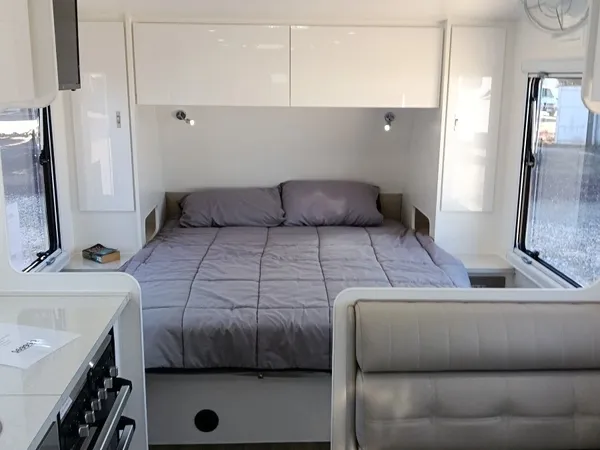
An island or north-south bed usually provides easier access from both sides.
That can be particularly useful for couples because each person can get in and out independently and there is often more convenient bedside storage.
An east-west bed can occupy less floor space, making it attractive in compact caravans, but one person may need to climb across the other depending on the design.
For shorter trips, that compromise may be insignificant. Over several months of travel, it may matter considerably more.
Full Ensuite vs Combined Bathroom
A combined shower and toilet can save substantial floor space and is therefore commonly suited to smaller caravans.
A full or separate ensuite usually requires additional caravan length but can provide greater privacy and convenience.
Couples intending to spend most nights at caravan parks may place less importance on a large onboard bathroom. Travellers frequently staying away from facilities may value it much more highly.
Café Dinette vs L-Shaped Lounge
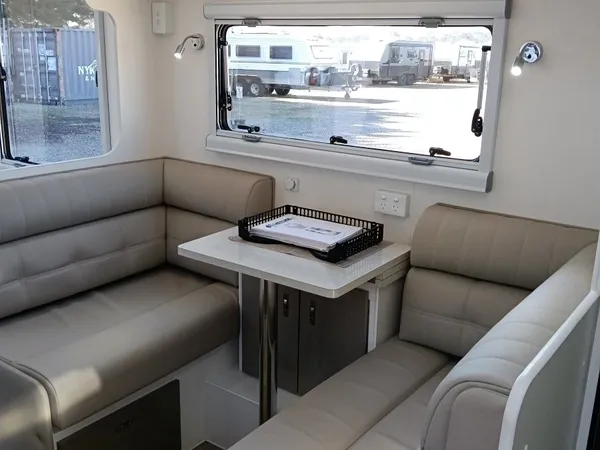
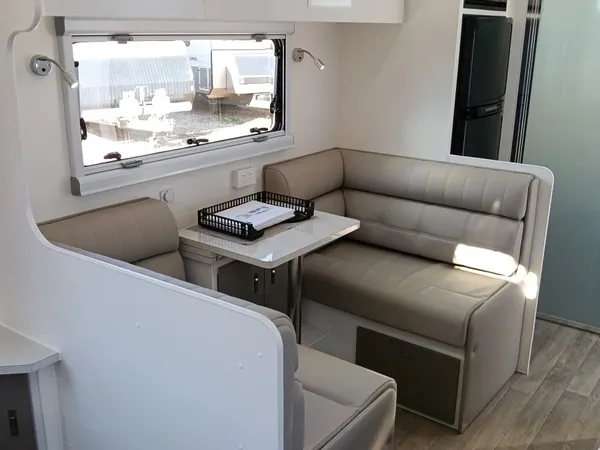
A café dinette generally provides two opposing seats and a central table, creating a practical arrangement for meals, working on a laptop or sitting opposite each other.
An L-shaped or club-style lounge can provide a more relaxed living area and potentially greater seating flexibility.
Neither layout is universally better. The key question is how much time you expect to spend inside the caravan and how you normally use the seating area.
Single Axle vs Tandem Axle Off Road Caravans for Couples
Couples do not automatically need either a single-axle or tandem-axle caravan simply because there are two occupants.
Single-axle caravans are commonly associated with shorter designs and can offer advantages in overall dimensions and manoeuvrability.
Tandem-axle caravans are commonly used in larger layouts where higher weights, greater interior space and increased carrying requirements come into play.
But axle count should never be considered in isolation.
The actual caravan weight, suspension system, payload, dimensions, braking system, tow vehicle and intended travel conditions all matter.
The researched 22ft Gold Class AC22C, for example, uses a tandem-axle configuration with a 4,495kg ATM, while the market contains much smaller couples caravans with very different weight and suspension requirements.
Choose the caravan first on its complete design and suitability for your travel rather than deciding that one axle configuration is inherently better.
Lightweight Off Road Caravans for Couples
One potential advantage couples have is that they do not need to dedicate large amounts of space and payload to extra beds.
That can create opportunities to buy smaller and potentially lighter caravans.
A lighter caravan may broaden tow-vehicle choice, reduce the total mass being towed and make manoeuvring easier.
But again, the word lightweight needs to be supported by actual specifications.
Across the current marketplace data researched for this guide, the median recorded ATM was 3,300kg, and approximately 73.1% of listings with valid ATM data were rated at 3,000kg or above.
This means buyers should not assume that an off road caravan designed for two people will automatically be light.
Check the caravan’s tare, ATM and available payload and consider what the caravan could actually weigh after loading water, gas, food, clothing, camping equipment and accessories.
Full Off Road vs Semi Off Road Caravans for Couples
One of the most important decisions is not how many people the caravan sleeps but where you actually intend to take it.
If you’re still comparing the broader category, our Off Road Caravans guide covers off road caravan types, market data, brands, models, prices and buying information in more detail.
The Australian Competition and Consumer Commission has specifically noted that there is no standard definition of “off-road” in the caravan industry. Manufacturers and suppliers therefore need to be clear about where a caravan is and is not designed to travel.
That makes the underlying specification more important than the badge on the side of the caravan.
If your travel is predominantly sealed highways, caravan parks and maintained gravel roads, you may not require the same equipment as someone regularly travelling on corrugated roads and more remote tracks.
Look at the caravan’s suspension, chassis, ground clearance, tyres, coupling, underbody protection and construction, but also read the manufacturer’s warranty and operating restrictions.
A caravan may look extremely rugged and still have limitations on where the manufacturer says it should be taken.
The best full off road caravan for a couple is therefore not necessarily the most heavily equipped caravan available. It is the caravan whose design and manufacturer-supported use align with the conditions you genuinely expect to encounter.
Off-Grid Features Couples Should Consider
Travelling as a couple can make resource planning easier because water and electrical consumption only need to support two people, but requirements still vary enormously according to travel style.
Solar and Battery Capacity
Battery capacity should be considered alongside the appliances you intend to use rather than as an isolated specification.
A couple relying primarily on lighting, pumps, phone charging and a refrigerator has very different electrical requirements from travellers regularly using induction cooking, high-output inverters, laptops, entertainment systems or electrically demanding climate-control equipment.
Solar capacity should similarly reflect expected energy use, battery size, weather conditions and the amount of time spent away from mains power.
Water Capacity
Water capacity is particularly important for remote touring.
There is no single correct number of litres for two people because consumption depends on showering, drinking, cooking, washing, climate and how frequently water can be replenished.
The researched SWAG SCT13, for example, publishes 200 litres of fresh-water capacity, illustrating how even a compact couples caravan can be configured for substantial water storage.
The more remote your travel, the more attention should be paid not only to fresh-water capacity but also to how water is stored, monitored and replenished.
Refrigeration, Cooking and Appliances
Refrigerator capacity should suit both the duration of your trips and the way you buy food.
Cooking arrangements can range from relatively simple gas or outdoor kitchens to larger indoor kitchens and induction systems.
Higher-draw appliances may also require larger batteries, solar systems and inverters, so the electrical system needs to be viewed as a complete package.
Heating, Cooling and Connectivity
Heating and cooling requirements vary considerably across Australia.
Couples travelling through alpine areas, inland regions and northern Australia can encounter very different climatic conditions during the same trip.
Air conditioning, diesel heating, fans and insulation can therefore be important depending on where and when you travel.
For long-term travellers, connectivity may also matter. Mobile coverage equipment, satellite communications and reliable charging can become essential for people working remotely or spending extended periods away from major towns.
Market data note: Listing counts and advertised asking prices reflect CaravansForSale.com.au data available at the time of publishing and may change as listings are added, updated or removed. Advertised prices are not confirmed sale prices.
How Much Does an Off Road Caravan for Couples Cost?
Off road caravan pricing varies enormously.
In the CaravansForSale.com.au market data used for this guide, there were approximately 3,018 active off-road advertisements, including 2,397 new and 580 used caravans.
The median advertised asking price was approximately $91,590 overall, compared with $97,490 for new caravans and $68,935 for used caravans.
These are advertised asking prices, not confirmed sale prices.
The median asking price for recorded 2-berth off-road caravans was approximately $88,995.
Price can be affected by construction, suspension, electrical systems, lithium battery capacity, solar, water storage, appliances, interior specification, brand and overall size.
Prices vary considerably across brands, sizes and specifications. Buyers who want to compare the broader market can browse all off road caravans for sale currently advertised across Australia.
Off Road Caravans Under $50,000
Under $50,000, couples may encounter smaller new caravans, older used caravans and comparatively simple specifications.
Buyers should compare not just purchase price but what equipment is included and what may need to be added later.
This range can open the door to more highly equipped compact caravans.
The researched SWAG SCT13 Couples sat within or around this bracket during the research period.
Features may include larger electrical systems, ensuites, increased water capacity and more extensive off-road equipment, although specifications vary considerably between brands.
Between $70,000 and $100,000, buyers may find larger conventional caravans as well as more comprehensively equipped compact and mid-size off-road models.
The researched Mars 16 Cruiser FHR – MK4 is one example of the type of two-person caravan that can appear in this part of the market.
Above $100,000, the market extends into premium and heavily equipped touring caravans.
These may offer higher specification electrical systems, premium suspension, larger interiors, luxury finishes and equipment intended for extended touring.
The researched Kokoda XC range starts from $139,000, the Crusader Musketeer Camelot has a published base RRP of $100,608, the Gold Class AC22C has a published RRP of $184,990 and the Lotus Trooper example researched for this guide was advertised at $172,990, demonstrating how far the premium end of the couples market can extend.
Buying new gives couples the opportunity to select current specifications, potentially customise options and purchase with the benefit of the applicable manufacturer and dealer warranty arrangements.
Used caravans can offer a lower purchase price and may already include useful accessories and upgrades installed by the previous owner.
The marketplace snapshot used in this guide showed a median advertised asking price of $97,490 for new off-road caravans compared with $68,935 for used caravans.
That difference should not be treated as a depreciation rate. The two groups contain different brands, years, sizes, conditions and specifications.
When buying used, inspect the caravan carefully for water ingress, structural damage, suspension condition, tyres, brakes, appliances, electrical equipment and signs of previous repairs or hard use.
Australian Consumer Law consumer guarantees can also apply when caravans are purchased from licensed dealers, and manufacturer or extended warranties do not replace statutory consumer rights.
How to Choose the Right Off Road Caravan for Two
The best approach is to start with your travel requirements and work backwards towards the caravan rather than choosing a floorplan first and trying to make everything else fit around it.
How Will You Use Your Caravan?
Consider the trips you actually expect to take.
A caravan used primarily for weekends and established caravan parks has very different requirements from one used for six-month trips through regional and remote Australia.
Think about the roads you expect to travel, how often you will stay away from mains power and water, how long you generally remain in one location and how much time you spend inside the caravan.
What Can Your Vehicle Tow?
Do not select a caravan based on ATM alone.
Tow-vehicle compatibility can also involve the vehicle’s braked towing capacity, GVM, GCM, axle capacities, towbar rating, tow-ball limits and actual loaded vehicle weight.
Payload also matters.
A caravan that looks suitable when empty can become substantially heavier after adding water, gas, food, clothing, tools and camping equipment.
Before buying, confirm the exact weights and ratings for both the caravan and tow vehicle.
How Much Space Do You Really Need?
One of the biggest advantages couples have is choice.
You can select a compact caravan because you genuinely prefer travelling light, or choose a 20ft-plus caravan and dedicate the extra space to a larger bathroom, kitchen, storage and living area.
Neither approach is inherently better.
Ask yourselves which features you would miss after several weeks on the road and which ones you would rarely use.
A slightly smaller caravan that fits your travel style is often more useful than a larger caravan carrying rooms and equipment you never need.
Find Off Road Caravans for Couples for Sale
The Australian market offers everything from compact two-person caravans through to fully equipped 20ft-plus off-road touring vans.
The right choice depends on how much you want to tow, where you want to travel and how much interior comfort you want once you arrive.
Whether you are looking for a compact off-road caravan for weekend travel, a lightweight option for easier towing or a larger two-person caravan for extended touring, comparing actual listings and specifications is the best place to start.
Share this article
Frequently asked questions (FAQs)
Ready to Find Your Dream Off Road Caravan?
Explore thousands of off road caravans for sale across Australia and start your journey in style.
Looking to buy? Browse caravans for sale from dealers and private sellers across Australia, with listings available by make, model, price, location and caravan type.
Looking to sell? If you're upgrading to a newer caravan or no longer need your current one, sell your caravan by creating a listing on CaravansForSale.com.au. Your advertisement stays online until it's sold for a one-time fee of $49.


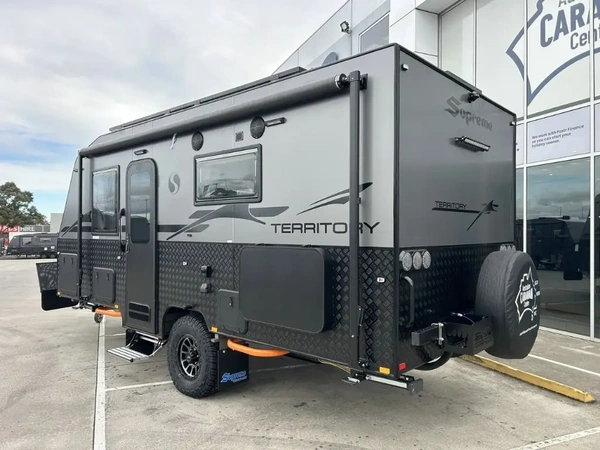
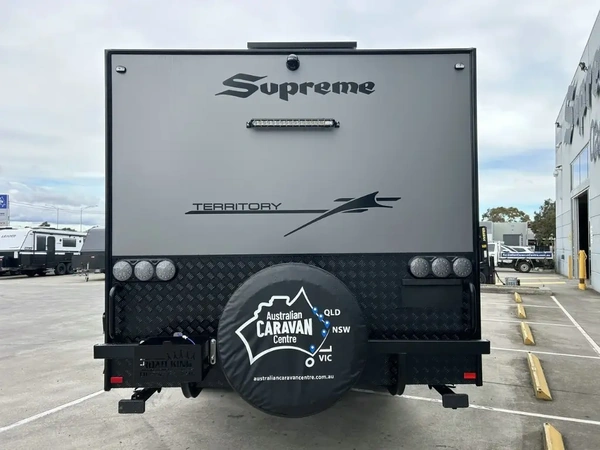
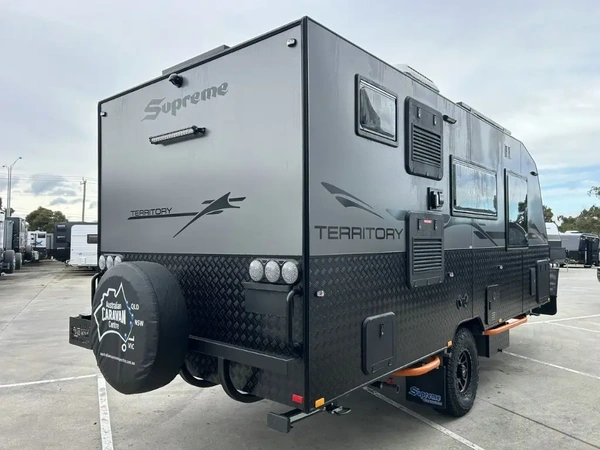
 Off Road Caravan
 2,978 Kg

 13 ft (4.0m)